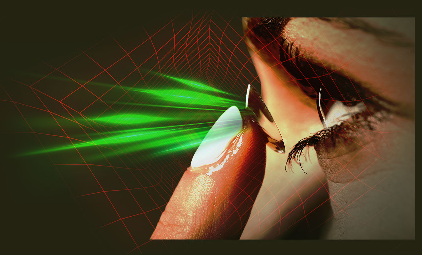
In a revolutionary scientific breakthrough that sounds straight out of science fiction, a team of Chinese researchers has developed infrared contact lenses that allow users to see in the dark — even with their eyes closed.
Developed by a consortium of optical physicists and nanotechnology engineers at a leading Chinese research institute, the next-generation smart lenses use advanced graphene-based sensors to detect infrared (IR) radiation and convert it into visible images for the wearer.
The lenses are embedded with nano-scale IR sensors that detect heat signatures emitted by objects and living beings. These signals are wirelessly transmitted to a wearable processor, which renders the information into images — allowing the wearer to perceive their surroundings even in total darkness or through physical barriers like eyelids.
The most remarkable feature? The system can still function with eyes closed, thanks to its direct interaction with the corneal surface and brain visual interface — a major advancement in wearable tech.
Lead scientist Dr. Liang Zhao explained:
“We’ve essentially expanded the natural limits of human vision. These lenses can operate like portable night vision goggles — without the bulk.”
The technology is non-invasive, lightweight, and energy efficient, and could pave the way for futuristic applications in military, rescue missions, medical diagnostics, and even augmented reality.
- Military and surveillance operations in darkness
- Search and rescue missions during disasters
- Medical use for detecting heat patterns linked to infections, inflammations, or tumors
- Smart vision tools for visually impaired individuals
- Future AR/VR integration for immersive environments
While the concept has passed lab testing and early clinical trials, the lenses are currently in the prototype phase. Researchers aim to begin human testing on a larger scale by early 2026, pending regulatory approvals.
This innovation represents a major leap in bio-integrated technology, blurring the line between biology and machinery. Infrared contact lenses could soon turn superhuman night vision into an everyday reality — reshaping how we see the world, quite literally.