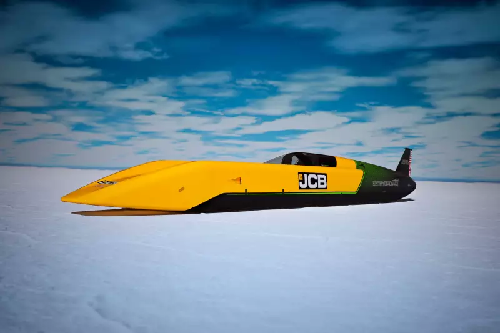
British construction equipment giant JCB is preparing to make motorsport history once again as it returns to the legendary Bonneville Salt Flats with its futuristic hydrogen-powered land speed racer, the JCB Hydromax.
The sleek 32.8-foot (10-metre) machine is aiming to exceed 350 mph (563 km/h) during its record attempt scheduled for August 2026, potentially setting a new benchmark for hydrogen-powered vehicles worldwide.
If successful, the Hydromax will almost double the current land speed record for a hydrogen internal combustion vehicle, set by BMW’s H2R prototype at 187.62 mph (301.95 km/h). It would also surpass the fastest hydrogen-powered vehicle of any type — the Buckeye Bullet 2 fuel-cell car from Ohio State University, which achieved 303 mph (487.7 km/h) in 2009.
The Hydromax is powered by two hydrogen internal combustion engines developed by JCB, each producing 800 horsepower. The engines are based on the same hydrogen technology already being adapted for the company’s production excavators, showcasing JCB’s commitment to alternative fuel innovation.
Power is delivered to all four wheels through a sophisticated twin-clutch dual-transmission system, while the entire vehicle has been engineered for maximum aerodynamic efficiency. According to the company, every detail — from suspension geometry and traction control to camera positioning — has undergone extensive simulation and stress testing before reaching the salt flats.
Behind the wheel will be legendary British driver Andy Green, the only person in history to break the sound barrier on land. Green already holds the outright world land speed record at 763.035 mph (1,227.9 km/h) and previously drove the diesel-powered JCB Dieselmax to a diesel land speed record of 350.092 mph (563.5 km/h) in 2006 — a mark that still stands today.
Speaking about the upcoming attempt, Green expressed confidence in the new machine’s capabilities.
“The JCB Hydromax car is lighter, more powerful, and faster than its predecessor of 20 years ago,” Green said. “Once again, we’re going to show the world just how good British engineering and technology really is. This August we’re going to smash the hydrogen-powered vehicle record in the world’s fastest zero-emissions vehicle.”
The ambitious project highlights the growing potential of hydrogen combustion technology and positions JCB at the forefront of sustainable high-performance engineering.