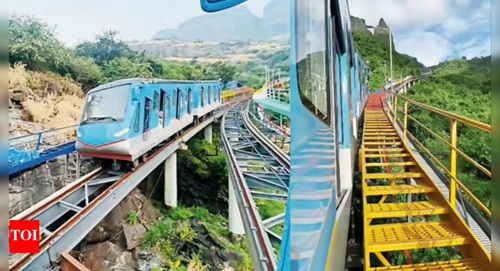
“Travel in India is getting a European-style upgrade as access to Malanggad (Haji Malang) in Thane has become significantly easier and faster.
Earlier, pilgrims had to undertake a challenging journey involving nearly two hours of trekking and climbing around 2,600 steps to reach the hilltop shrine. Now, that same journey can be completed in just 7–10 minutes.
This transformation has been made possible by India’s longest funicular railway (cable car) system, designed on the lines of similar systems in Switzerland. The project spans approximately 1.2 kilometers and is specially engineered for steep mountainous terrain.
The new service is expected to greatly improve accessibility, especially for elderly visitors, children, and women, making the pilgrimage far more convenient and inclusive.
The project, developed at a cost of around ₹93 crore, faced several delays due to technical and geographical challenges. However, with its launch, the region is now set to become a major attraction for both tourists and devotees.
The funicular system operates on a cable-based mechanism where one train ascends while another descends simultaneously. This design not only ensures safety but also enhances energy efficiency.”
Earlier, pilgrims had to undertake a challenging journey involving nearly two hours of trekking and climbing around 2,600 steps to reach the hilltop shrine. Now, that same journey can be completed in just 7–10 minutes.
This transformation has been made possible by India’s longest funicular railway (cable car) system, designed on the lines of similar systems in Switzerland. The project spans approximately 1.2 kilometers and is specially engineered for steep mountainous terrain.
The new service is expected to greatly improve accessibility, especially for elderly visitors, children, and women, making the pilgrimage far more convenient and inclusive.
The project, developed at a cost of around ₹93 crore, faced several delays due to technical and geographical challenges. However, with its launch, the region is now set to become a major attraction for both tourists and devotees.
The funicular system operates on a cable-based mechanism where one train ascends while another descends simultaneously. This design not only ensures safety but also enhances energy efficiency.”