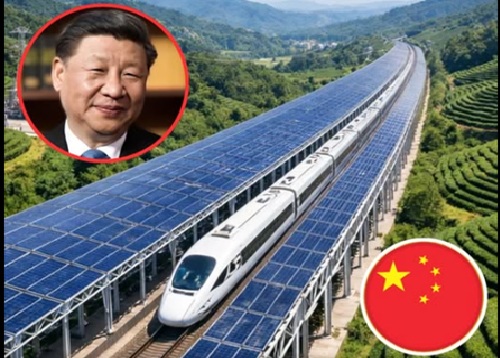
China has completed a fully solar-powered high-speed railway stretching 2,800 kilometers from Beijing to Guangzhou. According to the claim, the line operates entirely on clean energy generated by solar panels installed continuously along the track—creating the world’s first zero fossil fuel high-speed rail system.
However, experts confirm that this impressive-sounding project is not real. The widely circulated visuals and descriptions are part of a highly realistic AI-generated concept rather than an actual infrastructure development.
The idea of covering thousands of kilometers of active high-speed rail tracks with uninterrupted solar canopies presents major technical challenges. A project of this scale—estimated at around 6.8 gigawatts—would face serious issues related to maintenance, safety, weather exposure, and operational logistics, especially on trains running at speeds of up to 350 km/h.
Despite being fictional, the concept is rooted in real-world sustainability efforts. China continues to lead in renewable energy expansion and has already implemented solar solutions in practical ways, such as installing panels on the rooftops of large railway stations and transport hubs.
Globally, railway systems are exploring ways to integrate solar power into infrastructure, though in more feasible and modular forms rather than continuous trackside installations.
As artificial intelligence becomes more advanced in generating highly convincing visuals and narratives, experts stress the importance of verifying such claims before accepting them as fact.