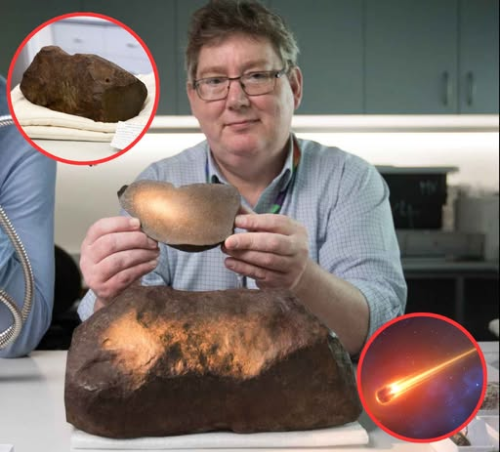
What began as a simple curiosity has turned into a remarkable scientific breakthrough after experts confirmed that an unusual rock is, in fact, an ancient iron meteorite formed at the very dawn of the solar system. Detailed analysis revealed that the object dates back more than 4.5 billion years, making it older than Earth itself and a rare survivor from the earliest era of planetary formation.
Iron meteorites are considered cosmic time capsules. Unlike ordinary rocks found on Earth, these objects originate from the metallic cores of early planetary bodies that never fully developed into planets. Violent collisions in the young solar system shattered these bodies, sending fragments like this meteorite drifting through space until some eventually fell to Earth.
Scientists emphasize that the value of such meteorites lies not in their commercial worth, but in the extraordinary scientific data they contain. Their internal crystal structures, chemical composition, and trace elements provide direct evidence of how planets formed, differentiated into layers, and evolved during the solar system’s infancy.
Unlike gold or other precious metals that form through geological processes on Earth, iron meteorites were forged in space under extreme conditions impossible to replicate naturally on our planet. By studying them, researchers can reconstruct events that occurred billions of years ago, offering clues about planetary cores, magnetic fields, and the building blocks of worlds.