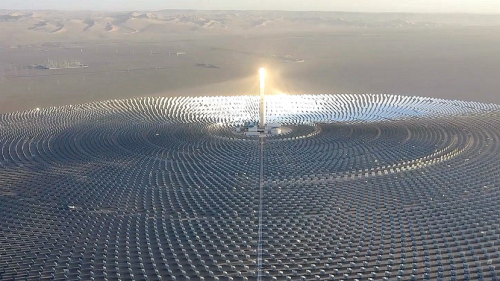
China is pushing the boundaries of clean energy with a massive concentrated solar power (CSP) installation in Dunhuang, Gansu, where 12,000 heliostats—computer-controlled mirrors—focus sunlight onto a towering 260-meter central receiver. The result is a solar plant that doesn’t sleep when the sun goes down.
At the heart of the project lies a molten-salt thermal storage system capable of holding up to 11 hours of dispatchable energy. During the day, the mirrors direct intense beams of sunlight toward the tower, heating molten salt to ultra-high temperatures. After sunset, the stored heat is used to produce steam, which drives a turbine to keep electricity flowing deep into the night. No lithium batteries. No sudden drop in output. Only heat, salt, and smart engineering.
CSP plants like this represent a different path from the lithium-ion battery boom: instead of storing electricity, they store thermal energy, allowing for long-duration power without the degradation issues batteries face. The Dunhuang facility stands as one of the world’s most advanced examples of this approach.
Adding a cutting-edge twist, researchers in China are increasingly relying on reinforcement learning algorithms to optimize heliostat operations. These AI systems adjust each mirror’s aim in real time, stabilizing the heat flux delivered to the central receiver and boosting overall plant efficiency. Early pilot studies have shown measurable gains in both output and equipment lifespan.
The global ripple effect is already visible. In the United States, engineers and policymakers are revisiting lessons from Nevada’s early tower projects, as the Southwest Sun Belt explores a new wave of solar plants paired with thermal storage. Improved materials, smarter controls, and AI-backed optimization are reshaping how CSP could complement traditional photovoltaic solar and large-scale batteries.
As nations race to decarbonize their power grids, Dunhuang’s glowing tower stands as both a technological beacon and a practical blueprint. It demonstrates a future in which sunlight collected during the day can illuminate entire regions long after nightfall—with mirrors, molten salt, and increasingly, machine intelligence.