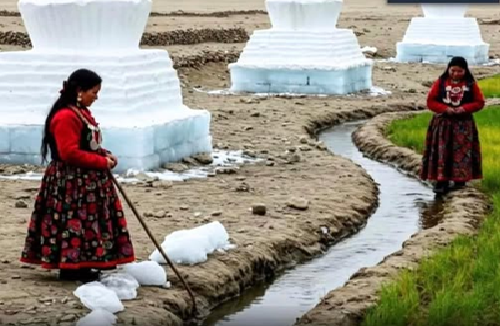
In the cold deserts of Ladakh, India, local women have pioneered an innovative solution to address water scarcity — the creation of Ice Stupas, which are artificial glaciers designed to store water during winter months. These structures, shaped like traditional Buddhist stupas, gradually melt in the warmer months, supplying much-needed water to local communities for drinking, irrigation, and daily use.
The Ice Stupas work by channeling snowmelt and stream water into large conical ice structures, which, due to their shape and slow melting rate, provide a sustained water supply during spring and summer when water is traditionally scarce. This ingenious approach not only tackles seasonal water shortages but also reduces dependency on distant glaciers and inconsistent rainfall.
Women in the region have played a central role in constructing and maintaining these ice structures, demonstrating both resilience and leadership in community-based climate adaptation. Their efforts highlight how traditional knowledge and innovative engineering can merge to solve modern environmental challenges.
Experts believe that the Ice Stupa initiative is a replicable model for other mountainous and arid regions, offering a sustainable and low-cost method to manage water resources. Beyond water conservation, the project also empowers women, fosters local innovation, and raises awareness about climate change in high-altitude communities.
This unique blend of culture, science, and social initiative shows that human ingenuity can mitigate environmental hardships, creating solutions that are not only practical but also deeply connected to the region’s heritage and way of life.