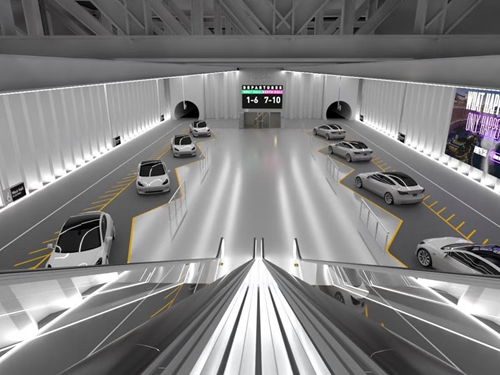
In the heart of Las Vegas, Elon Musk’s Boring Company has unveiled an ambitious underground transportation system known as the Vegas Loop, a network of tunnels designed exclusively for Tesla vehicles.
The system, which currently runs beneath the Las Vegas Convention Center, allows Tesla cars to transport passengers through narrow, neon-lit tunnels — bypassing the city’s often congested surface traffic. The project represents Musk’s vision of a faster, more efficient urban transport solution that operates below ground.
The Vegas Loop is designed to move passengers directly between key destinations in the city using self-driving or manually driven Teslas. The Boring Company plans to eventually expand the loop to cover the entire Las Vegas Strip, connecting major hotels, the airport, and downtown.
Supporters claim the tunnel system demonstrates a cost-effective, scalable alternative to conventional metro or subway systems — one that can be built faster and with less disruption to city life.
However, critics argue that the Vegas Loop falls short of being true public transportation. Because it excludes non-Tesla vehicles and carries only a few passengers per car, experts say it lacks the efficiency of mass transit options like subways or light rail systems.
Safety experts have also raised concerns over bottlenecks and emergency response access, given the tunnels’ confined design and limited exits.
Despite the criticism, the Boring Company remains optimistic. The Las Vegas project serves as a proof of concept for Musk’s long-term goal: building interconnected underground transport networks in major cities around the world to reduce traffic congestion.
The Vegas Loop currently transports thousands of passengers daily, and new construction is already underway to link the Resorts World complex and Harry Reid International Airport in the next expansion phase.