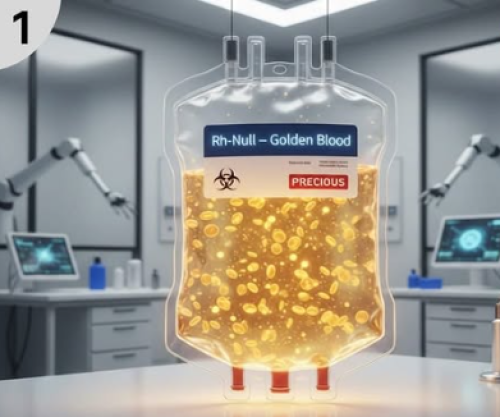
Known as Golden Blood, or Rh-null, the rarest blood group in the world is considered one of the most valuable assets in modern medical science. Its extreme rarity, scientific importance, and life-saving potential have made it a subject of deep interest among doctors, researchers, and geneticists worldwide.
Fewer than 40 people globally are known to possess the Rh-null blood group. What makes this blood unique is the complete absence of all 61 antigens of the Rh system, a feature that sets it apart from both Rh-positive and Rh-negative blood types. This extraordinary structure gives Rh-null blood unmatched compatibility in specific medical situations.
Because it lacks all Rh antigens, Golden Blood can be used as a universal Rh donor for patients with rare Rh-related conditions. In complex surgeries, emergency transfusions, and severe blood disorders, Rh-null blood often becomes the last and only hope for survival.
The term “Golden Blood” reflects not only its rarity but also its immense value. In several documented cases, blood banks have had to arrange international transfers, flying units of Rh-null blood across borders under special agreements to save critically ill patients.
However, possessing this rare blood type also comes with serious challenges. For individuals with Rh-null blood, finding a compatible donor during emergencies is extremely difficult. Many are advised to store their own blood in advance and remain in constant contact with specialized medical networks.
Beyond its clinical importance, Golden Blood plays a crucial role in genetic research. Studying Rh-null blood helps scientists better understand rare genetic mutations, blood disorders, and the evolution of human blood group systems. This research contributes to improved treatments and diagnostic methods for rare diseases.
Medical experts say the story of Golden Blood highlights the importance of blood donation and global cooperation. While only a handful of people carry this rare type, their willingness to donate has saved lives across continents.