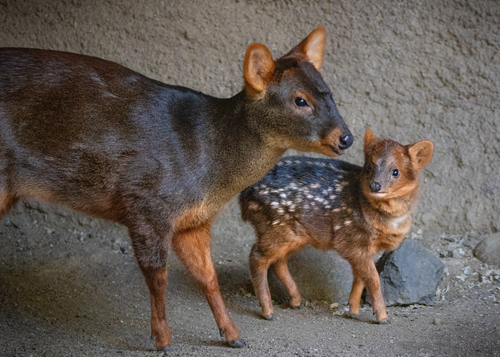
Valdivian temperate forests spanning southern Chile and southwestern Argentina, lives one of the most enchanting and diminutive members of the deer family: the Southern pudu (Pudu puda) recognized as the world’s smallest true deer species.
Standing only 32 to 44 cm (13 to 17 in) tall at the shoulder and weighing between about 6.4 kg and 13.4 kg (14 to 30 lb), this petite deer is a master of stealth and adaptation in one of the globe’s most verdant, rain-soaked ecosystems.
Southern pudus make their home in the thick understory of temperate evergreen rainforest, bamboo thickets, and lowland scrub, where dense vegetation offers protection and abundant food such as leaves, twigs, berries, bark and fallen fruit. Their compact size and short legs allow them to move nimbly through tangled forest floors that would challenge larger animals.
Despite their small stature, pudus are surprisingly agile. Their bodies are built for navigating shadows and thickets — they can clamber over roots, jump low obstacles and even stand on hind legs or balance on logs to reach leaves just out of reach. Their shy and cautious nature helps them avoid many predators, but their size also makes them vulnerable to threats like dogs, vehicles, and habitat loss.
Classified as Near Threatened by the IUCN, the southern pudu faces pressures from habitat fragmentation, logging and expanding human activity in its forest home. Conservation efforts aim to protect the remaining populations by preserving forest habitat and raising awareness about this remarkable species’ ecological role. For wildlife enthusiasts and casual observers alike, the southern pudu is a vivid reminder that size isn’t everything — and that even the smallest members of the natural world play indispensable roles in Earth’s rich biodiversity.