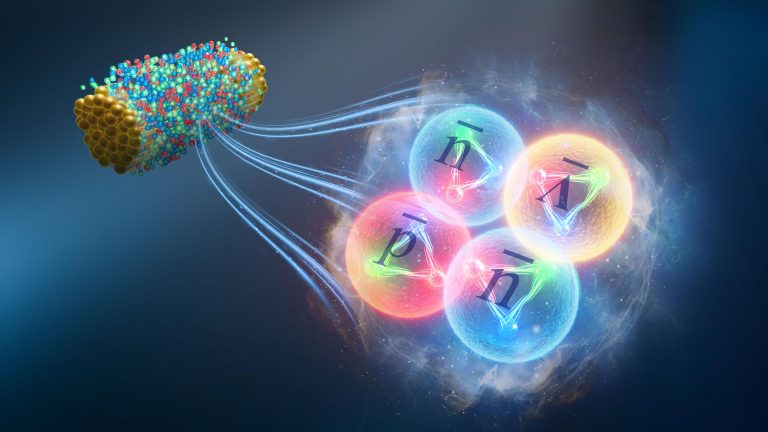
In a breakthrough that could rewrite our understanding of the universe, scientists at the Large Hadron Collider (LHC) have announced the discovery of the heaviest antimatter particle ever detected, smashing previous records and opening new frontiers in particle physics.
The discovery was made during high-energy collision experiments designed to probe the fundamental building blocks of matter and antimatter. Researchers observed an antimatter particle — a hyper-heavy antinucleus — far larger and more massive than any previously recorded, challenging current theoretical models.
“This is a landmark achievement,” said Dr. Elena Rossi, lead physicist at CERN. “Detecting such a massive antimatter particle pushes the boundaries of what we thought possible and provides crucial insights into the early universe’s conditions shortly after the Big Bang.”
Antimatter, composed of particles opposite to normal matter in charge and quantum properties, annihilates on contact with matter, making it extraordinarily difficult to detect and study. This new particle’s unprecedented mass and stability in collider conditions offer a rare glimpse into exotic states of matter.
The record-breaking particle was identified through collisions of heavy ions accelerated to near-light speeds, recreating conditions akin to microseconds after the Big Bang. Understanding these particles can help scientists unravel mysteries like why the observable universe is dominated by matter despite theories predicting equal amounts of matter and antimatter.
The findings, published today in Physical Review Letters, have sparked excitement across the physics community. Experts anticipate the discovery will fuel new research avenues, including antimatter’s role in cosmic evolution and potential applications in advanced medical imaging and energy.
As particle accelerators continue to push technological limits, humanity’s quest to understand the universe’s fundamental nature takes another giant leap forward — propelled by the power of the atom smasher and the secrets it reveals.