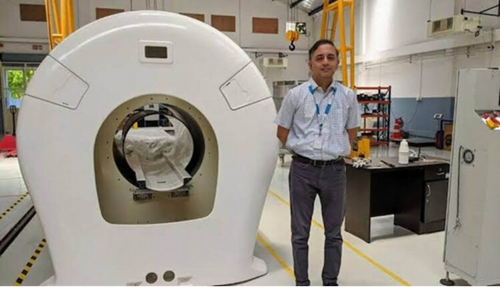
In a major breakthrough for India’s medical technology landscape, Bengaluru-based startup VoxelGrids has developed the country’s first fully indigenous 1.5-tesla Magnetic Resonance Imaging (MRI) scanner, now operational at the Chandrapur Cancer Care Foundation in Maharashtra. This achievement marks a significant step toward reducing India’s dependence on expensive imported imaging equipment from global manufacturers such as Siemens and GE Healthcare and is aligned with the nation’s Aatmanirbhar Bharat vision.
Under the leadership of founder Arjun Arunachalam, the VoxelGrids team spent over a decade designing and refining the system specifically for Indian healthcare needs. Unlike traditional MRI machines, the new scanner uses a helium-free “dry magnet” design, eliminating reliance on scarce and costly liquid helium coolants — a major factor in lowering production and operational expenses. This innovation has enabled the system to be about 40% cheaper to build than conventional MRI scanners. Beyond cost savings, the indigenous MRI machine also consumes less power and is lighter and more compact, making it easier to install in smaller hospitals and potentially even in mobile units for rural outreach. This design flexibility aims to make advanced diagnostics more accessible in smaller towns and underserved regions where access to high-end imaging has traditionally been limited.
To further expand accessibility, VoxelGrids offers a pay-per-use model that lowers the financial barrier for hospitals that cannot afford large upfront investments in imaging infrastructure. The scanner’s deployment at Chandrapur is seen as a watershed moment that could transform how advanced diagnostic imaging is delivered in India, potentially unlocking more affordable and widespread cancer, neurological, and musculoskeletal diagnostics across the country.