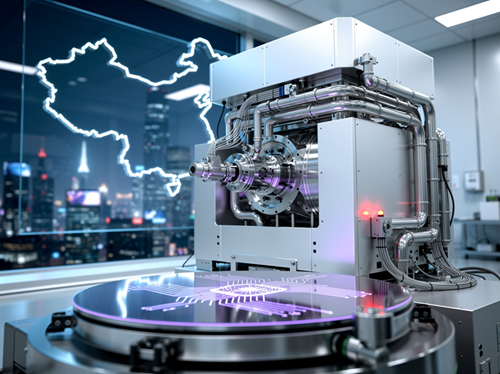
China has reportedly successfully built a prototype extreme ultraviolet (EUV) lithography machine — a technological milestone long seen as pivotal in the race for advanced semiconductor dominance. Developed inside a high-security Shenzhen laboratory, the prototype reportedly generates EUV light, the core capability needed to make the most advanced chips used in AI, smartphones and modern computing hardware.
Until now, ASML — the Dutch manufacturing giant — has held an effective global monopoly on EUV lithography systems, which are essential for producing chips at cutting-edge nodes below 7 nanometers. ASML’s CEO Christophe Fouquet has publicly stated that China was still “10 to 15 years behind” Western chipmaking capabilities due to export bans on EUV tools, reflecting industry assumptions that China would need many more years to catch up.
However, the existence of an operational prototype machine assembled in early 2025 suggests that China may be closing that gap faster than expected. According to sources familiar with the project, the Shenzhen system fills nearly an entire factory floor and already emits EUV radiation, although it has not yet manufactured commercially viable chips. Chinese authorities have set an ambitious goal of producing chips on the system by 2028, with analysts seeing 2030 as a more realistic timeline.
A critical factor in the accelerated timeline has been the recruitment of former ASML engineers, including specialists with experience in EUV light source technology. Some reports say engineers were brought into the project under false identities and tight security protocols, highlighting the sensitive nature of semiconductor know-how. Reverse engineering, secondary-market components from older ASML, Nikon and Canon equipment, and intense focused research have all contributed to the progress.Industry analysts describe the Chinese development effort as akin to a “Manhattan Project” for advanced chipmaking, combining state resources, high-level talent attraction and strategic parts acquisition to accelerate capability building.
Although China’s prototype machine is not yet equivalent to commercial ASML EUV tools in precision and reliability, its existence signals a major shift in the semiconductor landscape. Control over EUV technology has been central to Western export controls aimed at limiting Beijing’s ability to produce high-end chips independently. A working domestic EUV system, even in early form, could undermine those restrictions and accelerate China’s path toward chip self-sufficiency.
ASML and Western policymakers have long argued that cutting off access to EUV would keep China far behind in advanced semiconductor manufacturing. The Chinese milestone — achieved years ahead of many expert projections — challenges that assumption and could reshape strategic planning across the tech industry. Experts caution that producing commercial-grade chips on a homegrown EUV platform remains difficult. China still faces technological obstacles, especially in precision optics and system robustness, where Western suppliers — such as Zeiss in Germany — remain dominant. However, the prototype’s successful generation of EUV light is a significant proof-of-concept. If China continues to close the gap, global semiconductor dynamics could shift substantially over the next decade, with implications for AI development, national security technologies and international trade policies.