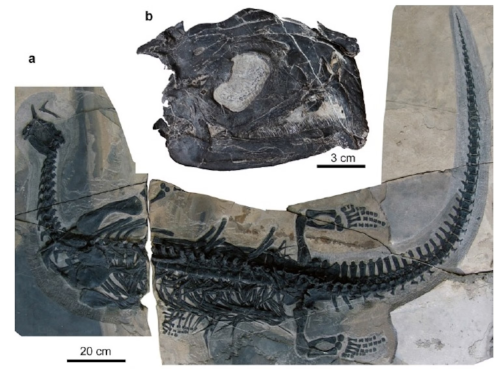
For decades, the skull of Atopodentatus unicus, an unusual marine reptile from the Triassic period, baffled paleontologists. Early fossil finds were crushed and incomplete, leading scientists to mistakenly interpret its strange jaw as belonging to a fish-eating predator.
Recent discoveries of better-preserved skulls have completely overturned that view. Researchers now understand that Atopodentatus unicus had a wide, hammer-shaped mouth lined with rows of small teeth, perfectly adapted for herbivorous filter feeding. This unique jaw structure allowed it to scrape and strain plant material from shallow waters, revealing a highly specialized diet previously unrecognized in Triassic marine reptiles.
The new reconstruction highlights the importance of continuous fossil discoveries in paleontology and demonstrates how scientific interpretations can evolve with better evidence. “It’s a perfect example of how paleontology is a constantly self-correcting science,” noted one researcher, emphasizing that initial misconceptions are often just stepping stones toward deeper understanding.
The case of Atopodentatus unicus serves as a reminder that even well-studied groups of extinct animals can still surprise us, and that careful analysis of new fossils can dramatically reshape our view of life on Earth hundreds of millions of years ago.