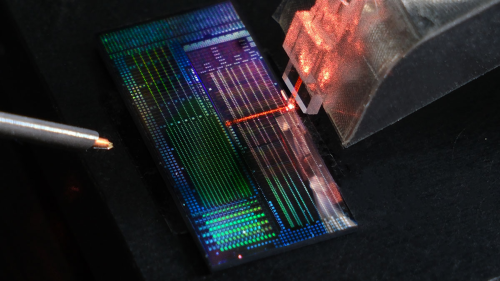
In a landmark breakthrough that could redefine the future of quantum computing, researchers from the University of Colorado Boulder and Sandia National Laboratories have solved one of the field’s most stubborn challenges—scalability. By shrinking a critical quantum control device to a size one hundred times thinner than a human hair, scientists have taken a major step toward practical, million-qubit quantum computers.
The research, published in Nature Communications in December 2025, introduces a revolutionary optical phase modulator capable of precisely controlling the lasers used to operate qubits in trapped-ion and neutral-atom quantum computers. Until now, these laser control systems relied on bulky, table-top equipment that occupied entire laboratories or warehouse-sized facilities, making large-scale quantum systems impractical.
Current quantum computers require hundreds or thousands of laser control channels, and future machines will need hundreds of thousands—or even millions. Scaling existing hardware to that level was considered nearly impossible. The newly developed chip changes that equation entirely. Consuming eighty times less microwave power than commercial modulators, it generates minimal heat and allows thousands of identical devices to fit onto a single microchip.
The technology works by harnessing ultra-fast mechanical vibrations—oscillating billions of times per second—to control laser phase with extraordinary accuracy. This precision is essential for reliably manipulating fragile quantum states without introducing noise or errors that can destroy calculations.
Perhaps the most transformative aspect of the breakthrough is its manufacturability. The device is built entirely using CMOS fabrication, the same industrial process used to manufacture smartphones, computers, and virtually every modern microchip. “CMOS is the most scalable technology humans have ever invented,” said Professor Matt Eichenfield, highlighting the potential for mass production at unprecedented scale.
Led by PhD student Jake Freedman, the research team is now integrating these modulators directly into real-world quantum computing systems. This step is expected to remove what many experts considered the final bottleneck preventing the development of million-qubit quantum computers.
Industry analysts say the impact could be profound. Compact, energy-efficient quantum control chips could accelerate breakthroughs in cryptography, drug discovery, climate modeling, artificial intelligence, and materials science.