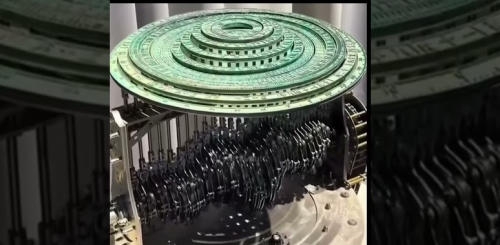
More than 2,400 years ago, long before the rise of modern machinery, robotics, or industrial science, ancient China achieved what once seemed impossible. During the Warring States period, a remarkable group of thinkers known as the Mohists transformed philosophy into practical engineering, creating mechanical innovations far beyond their era.
Led by the philosopher-engineer Mozi (470–391 BCE), the Mohists believed knowledge should serve humanity through usefulness and precision. Unlike other philosophical schools focused solely on ethics or governance, the Mohists combined logic, mathematics, and mechanics to solve real-world problems — giving rise to some of the earliest documented examples of automation.
Historical texts describe astonishing creations attributed to the Mohists, including self-moving wooden birds, early automated defensive systems, and mechanical devices designed to protect cities under siege. These were not legends or symbolic tales, but carefully documented engineering concepts rooted in measurable science.
Their groundbreaking ideas were recorded in the Mohist Canons, a collection of writings that explored principles of levers, pulleys, force, optics, geometry, and motion — centuries before similar concepts appeared in Western scientific thought. The Canons reveal an advanced understanding of cause and effect, structural balance, and mechanical efficiency that rivals much later scientific frameworks.
Scholars today view the Mohists as pioneers of applied science, proving that ancient civilizations were capable of extraordinary technical sophistication. Their work demonstrates that automation did not originate in modern laboratories or technology hubs, but in an age where wood, rope, and human ingenuity formed the building blocks of innovation.
This legacy challenges modern assumptions about the timeline of technological progress. The roots of automation, engineering logic, and mechanical design did not begin in Silicon Valley or the Industrial Revolution — they began in ancient China, where philosophy met precision engineering to reshape what humanity believed machines could do.