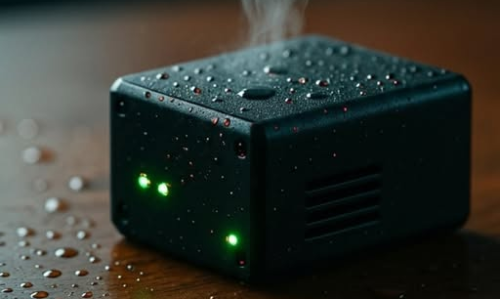
In a breakthrough that could redefine the future of clean energy, Japanese scientists have unveiled a matchbox-sized device capable of harvesting electricity directly from the air. This tiny innovation, developed at Japan’s National Institute of Advanced Industrial Science and Technology (AIST), taps into atmospheric humidity to produce a continuous electric current — without sunlight, wind, motion, or heat.
The device relies on a network of specially engineered nanomaterials that naturally attract ions present in humid air. As these ions interact with the surface, they trigger a steady and stable flow of electricity. Unlike traditional renewable sources that depend on environmental conditions such as daylight, wind speed, or mechanical movement, this technology works silently, invisibly, and around the clock.
In early laboratory tests, a single unit was able to power small sensors nonstop, proving for the first time that ambient humidity — something present everywhere on Earth — can serve as a reliable energy source. This marks a major leap in the search for decentralized and sustainable power solutions.
What makes the discovery even more remarkable is its simplicity: no turbines, no moving parts, no solar panels, no batteries, and zero emissions. All it needs is air — the same air that surrounds us every moment.
Researchers believe the implications could be transformative. Such devices could power remote villages, smart-home sensors, medical equipment in disaster zones, and even future electronics that operate without traditional charging. Instead of extracting resources from the planet, humanity could draw energy directly from the atmosphere, creating a system based on continuous renewal rather than consumption.