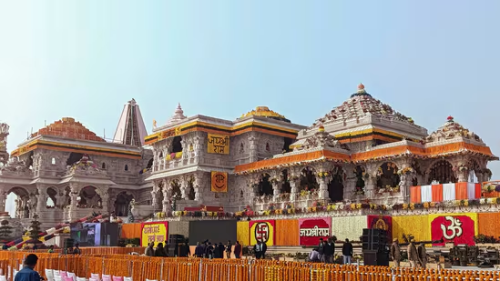
In one of the most ambitious temple construction projects in modern India, the Ram Mandir in Ayodhya has taken shape through the tireless efforts of more than 4,000 workers and craftsmen, supported by experts from CBRI Roorkee, IIT Madras, IIT Delhi, IIT Bombay, IIT Guwahati, and the Indian Institute of Astrophysics. The grand structure, designed to stand for the next 1,000 years, has been built entirely out of Bansi Paharpur sandstone, rising majestically to a height of 161 feet—without the use of a single piece of iron or steel.
The completion of the main temple marks a monumental moment for the nation. On November 25, Prime Minister Narendra Modi attended the flag-hoisting ceremony, commemorating the landmark progress. According to Nripendra Mishra, chairperson of the temple construction committee, nearly ₹1,800 crore of the ₹3,000 crore in donations has been utilized so far. Additional components—including extensive landscaping, a double-storeyed parkota (boundary wall), and a large auditorium—are expected to be completed by 2026.
Inside the temple, the Garbha Grah on the ground floor houses the revered Ram Lalla idol, carved from Krishna Shila, alongside 160 intricately carved pillars and 14 gold-plated doors. On the first floor, devotees will find the Ram Darbar, adorned with idols sculpted from Makrana marble, supported by 132 pillars, each reflecting the timeless craftsmanship of India’s stone artisans.
Constructed in the classic 5th-century Nagara architectural style, the Ram Mandir features five mandaps, designed for religious and cultural ceremonies, a 750-metre parkota, six subsidiary temples, and an elevated Parikrama Marg for circumambulation. Engineers involved in the project revealed that the greatest challenge lay in managing the immense scale of materials—from testing over 50 structural models to laying a 14-metre-deep foundation filled with 1.32 lakh cubic metres of concrete. Soil studies tracing remnants of the ancient Saryu River prompted construction of a massive granite plinth consisting of 24,000 stones to ensure long-term stability.
Beyond the main structure, work continues on surrounding infrastructure, including a 4-km boundary wall, expanded green zones, and the creation of Panchvati, a dedicated forest habitat for birds and animals. Notably, the GMR Group is contributing to the landscaping segment free of cost, under a five-year maintenance responsibility agreement.