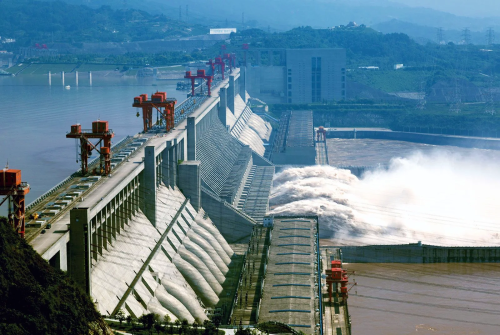
In a revelation that sounds like something out of a science-fiction documentary, NASA scientists have confirmed that China’s colossal Three Gorges Dam, the largest power station on Earth, is so massive that it has caused a measurable — though tiny — change in the planet’s rotation.
The dam’s reservoir, when filled to capacity, holds an astonishing 39.3 billion cubic meters of water. That’s the equivalent of more than 15 million Olympic-sized swimming pools concentrated in one region. When such a huge amount of mass is suddenly stored at a higher elevation compared to where the rivers once flowed freely, it changes Earth’s moment of inertia — the same physics principle that causes a spinning ice skater to slow down when they extend their arms.
NASA calculations concluded that the redistribution of this enormous mass has slowed Earth’s rotation by approximately 0.06 microseconds — millionths of a second. While the change is far too small to affect daily life, it is scientifically remarkable.
Experts explain that even slight shifts in the Earth’s mass can alter the speed of the planet’s rotation — similar to how earthquakes, glacial melt, and ocean currents make subtle contributions. But this case is different: it’s one of the clearest examples of human engineering impacting planetary physics.
The Three Gorges Dam, stretching 2.3 kilometers across the Yangtze River, has long been a subject of global discussion — praised for its monumental energy output and criticized for environmental and ecological costs, including habitat disruption and population displacement.
Yet, this newly highlighted effect adds another layer to the dam’s extraordinary legacy: a single infrastructure project, built by human hands, demonstrating enough influence to leave a fingerprint on Earth’s rotational behavior.
Scientists emphasize that such micro-changes pose no threat to the planet or human civilization, but the discovery underscores the sheer power of modern engineering — and how actions taken at the surface level can ripple out to the planetary scale.