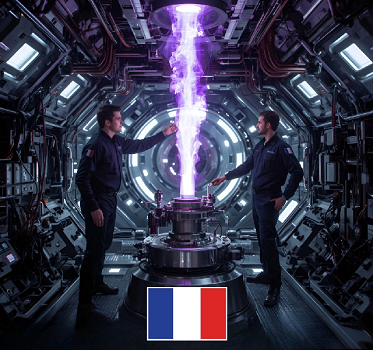
Scientists and engineers in France have made a significant leap in aerospace technology with the development of a revolutionary rocket engine that operates without any flame, fuel tanks, or moving parts. The engine, still in its prototype phase, runs on electromagnetic plasma and is poised to change the way spacecraft are propelled through the vacuum of space.
This new class of propulsion systems, often referred to as plasma thrusters, works on a fundamentally different principle than traditional chemical rockets. While chemical rockets generate thrust by igniting fuel and oxidizer to produce a high-speed exhaust of hot gases, a plasma thruster generates thrust by using electrical and magnetic fields to accelerate a superheated, ionized gas, or plasma.
The French innovation, developed from research at institutions like the École Polytechnique and the CNRS, builds on this concept. It generates a plasma and then uses strong electromagnetic fields to accelerate the charged particles out of the engine at incredibly high velocities. The result is a propulsive force that is continuous, highly efficient, and can operate for months or even years.
- No Combustion: The engine’s lack of a combustion chamber and traditional propellants like liquid oxygen and hydrogen eliminates the need for bulky fuel tanks, heavy pumps, and complex plumbing, significantly reducing the overall mass of the spacecraft.
- High Efficiency: Plasma thrusters have a much higher specific impulse than chemical rockets, which is a measure of how efficiently a rocket uses its propellant. While they produce very low thrust, their high efficiency allows them to achieve very high speeds over long periods of time, making them ideal for long-duration interplanetary missions.
- Sustainability: By using inert gases like xenon or argon as a propellant, plasma thrusters offer a more sustainable alternative to chemical fuels and can potentially be powered by on-board solar arrays or even nuclear reactors.
While the technology is extremely promising for missions in deep space, it’s not a viable solution for launching rockets from Earth. The thrust generated by plasma engines is far too low to overcome the planet’s gravity. However, once in orbit, a plasma-powered spacecraft could slowly and steadily accelerate to speeds far beyond the reach of conventional rockets.
French companies like ThrustMe are already leading the way in developing and commercializing similar technologies for satellite constellations. The ongoing development of this flameless, fuel-free engine represents a major step towards making space travel more efficient and accessible for future missions to the Moon, Mars, and beyond.