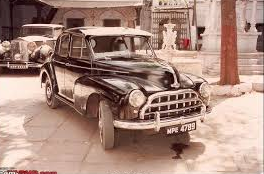
Hindustan Motors Ltd, established in 1942, was India’s first automobile manufacturing company. This was followed by Premier Automobiles (1944) and Standard Motor Products of India Ltd (1948), marking the early years of Indian automotive history.
India’s First Locally Assembled Car – Hindustan 10 (1946):
The Hindustan 10 was India’s first car to be built domestically.
It was not fully indigenous but was identical to the Morris 10 HP (Series M) from the UK.
Manufactured at Hindustan Motors’ factory in Uttarpara, West Bengal.
Production began in 1946, just before India’s independence.
- Hindustan Motors Ltd (1942):
Became famous for the Ambassador (based on the Morris Oxford Series III).
Dominated the Indian market for decades, especially among government officials and taxi services.
- Premier Automobiles Ltd (1944):
Launched the Premier Padmini, which became an iconic car in Indian cities.
Collaborated with Fiat for its early models.
- Standard Motor Products of India Ltd (1948):
Known for models like the Standard Herald and Standard 2000.
Eventually exited the market due to increasing competition.
Laid the foundation for India’s automobile manufacturing sector.
Introduced the first domestically produced cars, leading to self-reliance in vehicle production.
Paved the way for later government and private automotive ventures, including Maruti, Tata, and Mahindra.
India’s journey toward fully indigenous car manufacturing, which materialized in the 1980s and beyond.
The Hindustan 10 (1946) and its successors set the stage for India’s automotive evolution, making the country one of the largest car manufacturers in the world today.