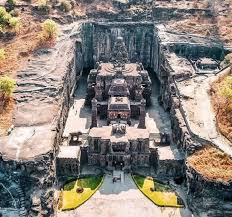
The Ellora Caves are a group of monumental rock-cut temples located in the Aurangabad District of Maharashtra, India. These caves, carved into the basalt cliffs of the Vaidurya hills, are one of the most remarkable and extensive cave complexes in the world. They span a period of over 500 years (from the 5th century to the 10th century CE), showcasing the diverse religious traditions and the rich cultural history of the region.
- The Ellora Caves were constructed by successive dynasties, primarily by the Rashtrakutas, and they represent a blend of Buddhist, Hindu, and Jain religious traditions.
- The caves were originally used as monastic retreats, temples, and places of worship. The artwork, carvings, and architectural features reflect the evolving religious practices and cultural expressions over the centuries.
- The caves were carved using primitive tools, and the artistry and engineering feats demonstrate the high level of craftsmanship and devotion of the artisans.
- The Ellora Caves are notable for their diversity, with the cave complex including:
- 12 Buddhist Caves: Primarily used by Buddhist monks, these caves feature intricate sculptures, stupas, and monastic viharas (residential quarters).
- 17 Hindu Caves: These caves include temples dedicated to various deities like Shiva, Vishnu, and Ganesh, reflecting the religious prominence of Hinduism in the region.
- 5 Jain Caves: Dedicated to the Jain Tirthankaras, these caves are characterized by intricate carvings, elaborate facades, and detailed sculptures of Jain deities.
- The Kailasa Temple is the most famous and awe-inspiring feature of the Ellora complex. It is located in Cave 16 and stands as the largest single monolithic rock excavation in the world.
- This massive temple is carved out of a single rock and was built by the Rashtrakuta dynasty in the 8th century. The temple is dedicated to Lord Shiva and is a stunning representation of Hindu architecture and devotion.
- The Kailasa Temple is so vast that it is often referred to as a “reverse pyramid” because it was carved from the top down, and its structure includes multiple levels and intricate details. It is known for its towering shikhara (spire), courtyard, and intricate sculptures depicting scenes from Hindu mythology.
- The entrance porch of the Kailasa Temple is adorned with sculptures of various deities, and the temple’s sanctum houses a massive Shiva Linga (the representation of Lord Shiva). The sculptural reliefs throughout the temple depict mythological stories, including scenes from the Ramayana and Mahabharata.
- The architecture of Ellora is a blend of Indian rock-cut architecture, where structures were carved directly into the cliff face. This is a highly skilled form of construction that involved both digging into solid rock and sculpting intricate designs.
- Many caves feature elaborate pillars, doorways, and decorative elements that reflect the distinctive artistic styles of the respective religious sects.
- The Kailasa Temple stands out for its sculpted monolithic pillars, intricate carvings of gods and goddesses, and friezes that narrate religious and mythological stories.
- This cave contains a large prayer hall (Vihara) with stupas, Buddha statues, and a central meditation hall. It showcases Buddhist rock-cut architecture and sculpture.
- Cave 10 (Vishvakarma Cave – Hindu): It contains a shrine to Lord Vishvakarma, the divine architect, with an elaborate Nandi (bull) statue, reflecting the religious significance of Hindu worship in the region.
- This cave features highly detailed figures of Tirthankaras and elaborate sculptures depicting scenes from Jain texts.
- Ellora Caves are a UNESCO World Heritage Site, designated in 1983. This recognition highlights the complex’s historical, architectural, and cultural significance.
- The caves represent a blend of religious traditions and are an exceptional example of Indian rock-cut architecture, demonstrating a high level of craftsmanship.
- The sculptural artistry of the Ellora Caves is among the finest in India. The caves are renowned for their iconography, depicting scenes from Hindu, Buddhist, and Jain mythology. Buddha sculptures, Shiva’s cosmic dance, mythical battles, and divine figures are prominent throughout the caves.
- The craftsmanship seen in the Kailasa Temple, for example, is a blend of religious devotion and architectural ingenuity. The storytelling sculptures on the walls of the caves depict scenes from epic literature such as the Mahabharata, Ramayana, and Puranas.
- The elaborate carvings also serve as a window into the rich cultural and religious life of the time, showcasing the diversity of thought and religious practices in ancient India.
- The Ellora Caves are one of the most popular tourist destinations in Maharashtra. The site is well-connected and accessible from Aurangabad (about 30 km), and visitors can explore the caves on foot or by guided tours.
- The Ellora Festival of Dance and Music, held annually, is a major cultural event that showcases classical dance and music performances in the backdrop of the caves, adding to the site’s cultural appeal.
- Given the age and fragility of the caves, ongoing conservation and preservation efforts are undertaken by the Archaeological Survey of India (ASI) to protect the structures from damage due to weathering and human activity.
- Proper management of the site ensures that its intricate artwork, sculptures, and architectural features are preserved for future generations.
The Ellora Caves are not just an architectural marvel but also a testament to India’s rich cultural and religious diversity. The site offers an immersive experience into the spiritual practices, artistic expression, and technological prowess of ancient India. The Kailasa Temple, in particular, stands out as a symbol of human ingenuity, having been carved entirely from a single monolithic rock, and remains one of the largest rock-cut temples in the world.