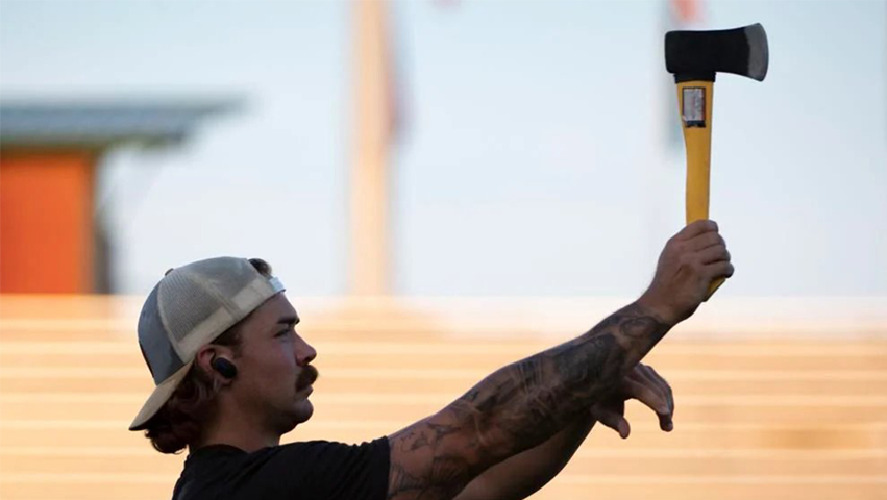
The world record for the farthest distance axe throw has once again changed hands, with an American athlete reclaiming the title after years of intense competition and rapid progression in one of the world’s most unconventional sports.
The latest record was set by a U.S.-based axe thrower who hurled a standard competition axe farther than any verified throw before it, reclaiming a mark that has become increasingly hotly contested in recent years. Officials confirmed that the throw met all measurement and equipment standards, officially restoring the record to American hands.
Axe throwing, once a niche pastime associated with lumberjack festivals and rural competitions, has evolved dramatically over the past two decades. The modern sport now features standardized rules, specialized axes, professional leagues, and athletes who train specifically for power, technique, and release mechanics.
Early distance records were often set with limited oversight and varied equipment, making comparisons difficult. As international interest grew, governing bodies introduced stricter regulations, ensuring consistency and allowing athletes to push the limits under fair conditions. With clearer rules came rapid improvements—and fierce rivalry.
The U.S. record-holder’s achievement reflects that evolution. Unlike traditional target axe throwing, distance throwing focuses on maximizing launch speed and optimizing rotation while maintaining control. Athletes analyze grip pressure, foot placement, release angle, and even wind conditions. Small refinements can translate into dramatic gains over long distances.
“This is as much physics as it is strength,” the record-holder said after the throw. “You’re trying to send a rotating object as efficiently as possible through the air. Every detail matters.”
The record has changed hands multiple times in recent years, with competitors from North America and Europe pushing each other to new extremes. Social media and video sharing have amplified interest, turning record attempts into viral events and drawing new athletes into the sport.
Experts say the rapid progression mirrors what happens in emerging sports once participation increases and techniques are shared more widely. “We’re seeing the same pattern as early track and field or strongman events,” said a sports historian. “Once people realize what’s possible, progress accelerates.”