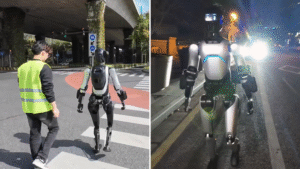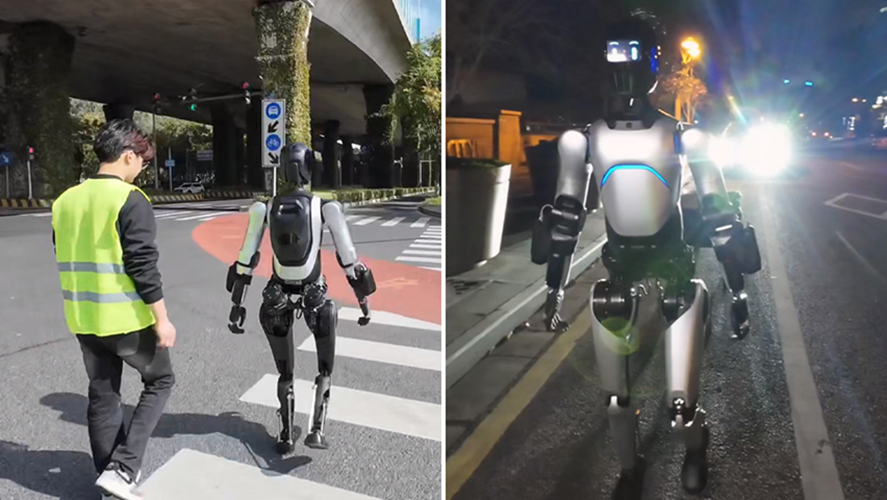
A humanoid robot has captured global attention after successfully walking more than 100 kilometers across public roads in China, a feat experts are calling a major milestone in robotics and artificial intelligence.
Developed by a Chinese tech company and research team, the bipedal robot completed the long-distance journey over several days, navigating uneven terrain, slopes, and crowded urban environments. Videos shared on social media showed curious passersby stopping to film as the human-shaped machine strode steadily forward, occasionally adjusting its posture to maintain balance.
According to engineers involved in the project, the demonstration was designed to test the robot’s endurance, autonomy, and real-world adaptability rather than speed. Unlike short lab-based trials, the extended walk required the robot to continuously process data from sensors, cameras, and AI-driven control systems while managing power consumption and mechanical stress.
“This is not just about walking,” one project engineer said. “It’s about sustained operation in an open environment, where conditions are unpredictable. That’s the real challenge for humanoid robots.”
The robot’s design closely resembles human proportions, allowing it to move with a natural gait. Advanced joint motors, reinforced leg structures, and real-time balance algorithms enabled it to walk for long periods without human intervention. Engineers noted that the robot was able to recover from minor slips and adjust to changing surfaces—abilities considered critical for future real-world applications.
China has heavily invested in robotics as part of its broader push to lead in artificial intelligence and advanced manufacturing. Humanoid robots are seen as a key frontier, with potential roles in logistics, elderly care, hazardous industrial work, and disaster response. This long-distance walk, analysts say, signals that Chinese firms are closing the gap with global competitors in embodied AI.
Industry experts also highlighted the symbolic value of the demonstration. “Walking 100 kilometers is something humans associate with endurance and resilience,” said a Beijing-based robotics analyst. “Seeing a robot do this in public space changes how people perceive machine capability.”
While the robot is not yet ready for commercial deployment, developers say the data collected during the journey will be used to refine hardware durability and improve AI decision-making. Future tests are expected to include carrying loads, navigating stairs, and interacting more closely with humans.