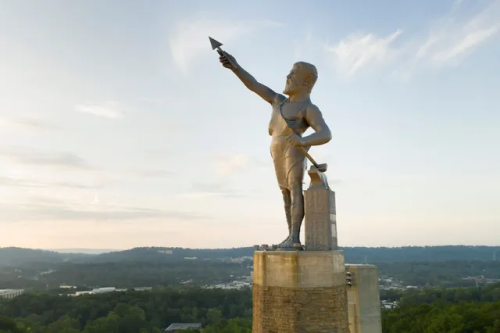
world’s largest cast-iron statue, the iconic Statue of Vulcan. Standing an impressive 56 feet (17 meters) tall and weighing approximately 50 tons, Vulcan is a monumental symbol of America’s industrial age and Birmingham’s deep roots in iron and steel production.
The statue depicts Vulcan, the Roman god of fire and metalworking, holding a hammer and anvil—an apt representation of the city’s role as a major iron-producing hub during the late 19th and early 20th centuries. Cast entirely from iron, the statue was originally created for the 1904 St. Louis World’s Fair, where it showcased Birmingham’s industrial strength to the world.
After the fair, the statue was relocated to Birmingham and later placed atop Red Mountain, overlooking the city. Over the decades, Vulcan has undergone careful restoration to preserve its historic structure while maintaining its status as a towering landmark. Today, it stands proudly in Vulcan Park and Museum, offering panoramic views of the city and serving as a centerpiece of local heritage.
Historians and engineers alike regard Vulcan as a rare achievement in large-scale cast-iron sculpture. “Creating a statue of this size entirely from cast iron was an extraordinary feat for its time,” noted a museum curator. “It remains unmatched in scale and craftsmanship.”