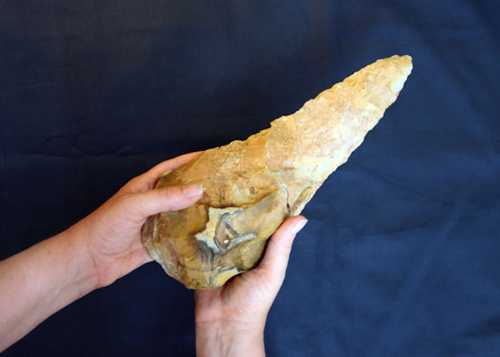
Archaeologists working in England have uncovered a rare and fascinating discovery: a pair of “giant” stone handaxes believed to be around 300,000 years old, dating back to a time when Neanderthals or other archaic human species roamed the region. The find is drawing global attention due to the unusual size of the tools, which challenge conventional ideas about prehistoric technology.
The largest of the two handaxes measures just under one foot in length, making it significantly bigger than typical handaxes from the same era. Researchers noted that the tools are so large and heavy that it is “difficult to imagine how they could have been easily held and used,” raising questions about their original purpose.
One theory suggests that the oversized axes may have served a symbolic role, possibly as a display of strength, craftsmanship, or social status among early humans. Creating such massive tools would have required exceptional skill and effort, potentially making them a form of prehistoric prestige object rather than everyday equipment.
However, archaeologists have not ruled out practical uses. The tools may have been designed for butchering large animals and cutting thick meat, especially given the formidable prey that lived in the region at the time. Evidence suggests that early humans in the area hunted horses, red deer, and possibly even straight-tusked elephants, animals that would have required powerful and durable tools to process.
The discovery provides new insight into the adaptability and ingenuity of early human species. Whether symbolic or functional, the giant handaxes highlight a period when humans were experimenting with tool size and capability in response to their environment and survival needs.
Experts say the find adds an important chapter to the understanding of prehistoric life in Britain, showing that early humans were not only skilled toolmakers but also capable of producing objects that went beyond standard utility.