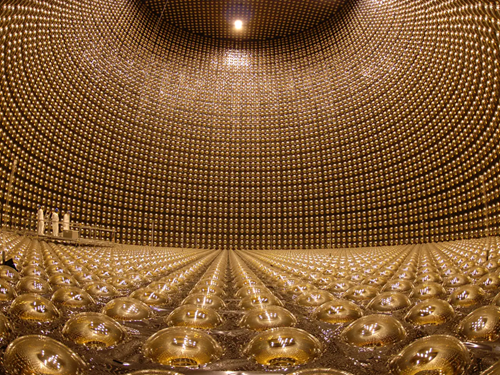
Deep beneath Mount Ikeno in Gifu Prefecture, Japan, scientists operate one of the world’s most remarkable scientific instruments: the Super‑Kamiokande neutrino detector, a giant underground observatory that quietly watches the universe’s most elusive particles.
Sitting about 1,000 meters below the Earth’s surface in the Mozumi Mine, the detector consists of a huge cylindrical tank filled with roughly 50,000 tons of ultra‑pure water more than enough to fill several Olympic swimming pools and is lined with over 11,000 ultra‑sensitive photomultiplier tubes that can detect faint light.
The tank’s mission is to catch neutrinos, tiny nearly massless particles that are produced in nuclear reactions inside the Sun, during supernova explosions, and in Earth’s atmosphere. These particles stream through space and through matter, including the Earth and our bodies almost without interacting at all. But on rare occasions, a neutrino collides with a water molecule in the detector, producing a faint flash of light called Cherenkov radiation. The array of sensors detects this light, allowing scientists to reconstruct the interaction.
Super‑Kamiokande has helped revolutionize our understanding of fundamental physics. In the late 1990s, observations made at the detector provided strong evidence that neutrinos oscillate between different types a phenomenon that can only occur if neutrinos have mass, reshaping long‑held assumptions in particle physics and contributing to a Nobel Prize‑winning discovery.
Beyond fundamental particle studies, the observatory also acts as a cosmic early‑warning system for supernova explosions in our galaxy. When massive stars collapse at the end of their lives, they release vast numbers of neutrinos well before light from the explosion reaches Earth. Super‑Kamiokande’s sensitive detection capabilities make it possible to spot these neutrinos, offering scientists an advanced alert to one of the universe’s most dramatic events.
Hidden far below a Japanese mountain, this giant water‑filled tank continues to provide scientists with a unique window into astrophysical processes and the inner workings of the universe proving that some of nature’s most subtle phenomena can be observed with ingenuity and patience.