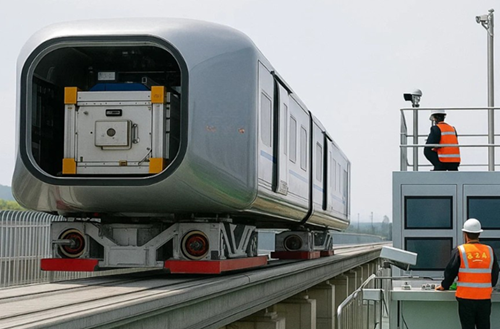
China has pulled back the curtain on a groundbreaking magnetic levitation (maglev) cargo transport system capable of whisking freight at aircraft-like speeds while gliding almost silently along dedicated tracks an innovation that could revolutionize how goods are moved across continents.
Developed by the China Aerospace Science and Industry Corporation (CASIC), the system employs superconducting magnets to levitate freight pods mere millimetres above the track, nearly eliminating friction and the mechanical wear common in conventional rail or truck transport. In recent tests the technology has successfully moved cargo at speeds up to around 620 km/h, matching high-speed aircraft performance without the noise or fuel demands.
What sets this system apart is that each freight pod operates autonomously, using artificial intelligence (AI) to manage routing, traffic flow and even the intricate process of loading and unloading all with minimal human intervention. Automated robotic systems can transfer goods from ports and warehouses directly onto maglev pods, drastically reducing handling time and boosting overall logistics efficiency.
CASIC engineers claim the technology could cut energy consumption by up to 70 % compared with traditional air freight, while also bypassing highway congestion and reducing maintenance costs since there’s virtually no mechanical contact with the track. This makes the maglev cargo system both eco-friendly and cost-effective, particularly for overnight freight routes between major urban centres.
The use of superconducting levitation also contributes to near-silent operation a welcome feature in urban and residential areas and the reduced friction means wear-and-tear on infrastructure is drastically lowered. That opens the door to 24/7 freight movement on high-speed corridors connecting industrial hubs, ports and inland markets without the environmental footprint of air or road freight.
China’s new maglev cargo system not only pushes the boundaries of transportation engineering but also showcases how AI, advanced materials and sustainable design can converge to reshape global supply chains potentially setting a new standard for next-generation freight transport.