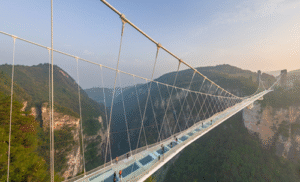
Rising dramatically above a deep canyon in Zhangjiajie National Forest Park, the Zhangjiajie Glass Bridge has rapidly become one of the world’s most recognizable feats of modern engineering, drawing visitors from across the globe. Set amid the towering sandstone pillars that inspired the floating mountains in the film Avatar, the bridge offers a heart-stopping experience—allowing tourists to look straight down through transparent glass panels into the vast landscape below.
Stretching high above the canyon floor, the bridge combines awe-inspiring design with advanced structural safety. Its walking surface is made from triple-layered reinforced glass, supported by powerful steel cables capable of enduring extreme loads, high winds, and harsh weather conditions common to the mountainous region.
To demonstrate its strength, engineers subjected the bridge to dramatic stress tests before opening it to the public. Glass panels were struck repeatedly with hammers, and in one widely publicized test, a vehicle was driven across the surface to prove its durability. Despite visible surface cracking during demonstrations, the glass remained structurally intact, reassuring both experts and visitors of its safety.
Since its opening, the bridge has transformed Zhangjiajie into a global tourism hotspot. Visitors from dozens of countries come not only for the thrill of walking on glass suspended hundreds of meters above the ground, but also to experience the seamless blend of nature and modern engineering.
Architectural analysts note that the project represents China’s growing confidence in large-scale, innovative infrastructure. “This bridge is not just about excitement,” one engineer explained. “It shows how advanced materials, precise calculations, and bold design can coexist with natural landscapes.”
Beyond tourism, the Zhangjiajie Glass Bridge stands as a symbol of how architecture can enhance appreciation of natural beauty rather than overshadow it. By offering an unobstructed view of the canyon below, the bridge encourages visitors to engage more deeply with the environment while challenging their sense of scale and perspective.