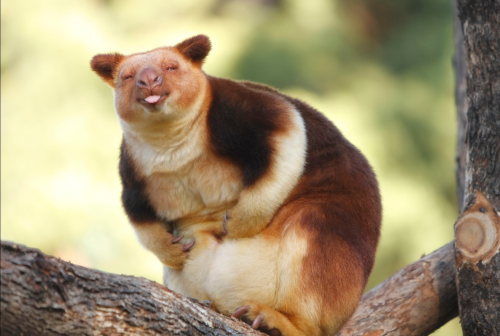
One of the world’s rarest and most elusive mammals, the Wondiwoi tree kangaroo, has re-emerged from the brink of extinction, offering new hope for global wildlife conservation. Native to the remote montane forests of the Wondiwoi Peninsula in Papua, Indonesia, on the island of New Guinea, this extraordinary species is known for its isolation and near-mythical status among scientists.
The Wondiwoi tree kangaroo was first scientifically described in 1928. Following that initial documentation, the species vanished from confirmed records for nearly ninety years. Despite numerous surveys and expeditions, no verified sightings were made, leading many experts to believe that the animal had quietly gone extinct due to habitat loss, hunting, or environmental change.
That assumption was dramatically overturned in 2018 when British naturalist Michael Smith successfully photographed a living Wondiwoi tree kangaroo deep within the dense rainforest of the Wondiwoi Mountains. The images provided the first concrete evidence in decades that the species had survived in extreme isolation, hidden within one of the most inaccessible forest regions in Southeast Asia.
Adapted perfectly to life in the trees, the Wondiwoi tree kangaroo is a medium-sized marsupial with powerful limbs designed for climbing and leaping between branches. Its long, muscular tail provides balance, while its thick fur protects it from the cool, misty conditions of the high-altitude forests it inhabits. Unlike ground-dwelling kangaroos, this species spends most of its life in the canopy, feeding on leaves, fruits, and shoots.
Conservationists say the rediscovery highlights the importance of preserving remote ecosystems that remain poorly studied. The forests of Papua are among the most biologically rich yet least explored regions on Earth, harboring species found nowhere else.
Experts are now calling for urgent conservation measures to protect the Wondiwoi Peninsula from deforestation and human encroachment. Further research is also planned to estimate the population size and assess the species’ long-term survival prospects.