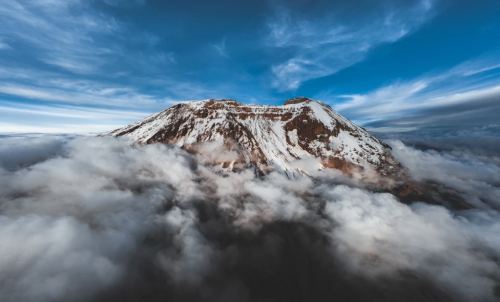
Standing proudly at 19,341 feet (5,895 meters), Mount Kilimanjaro remains one of the most iconic natural landmarks on Earth. Located in northern Tanzania, the mountain holds the title of the tallest free-standing mountain in the world, rising abruptly from the surrounding savannah rather than forming part of a range. This vertical dominance gives Kilimanjaro a silhouette unmatched anywhere else on the continent.
Beyond its incredible height, Kilimanjaro is celebrated for its astonishing ecological diversity. The mountain is home to five distinct climate zones, each resembling an entirely different ecosystem — a rarity in geography and a magnet for scientists, trekkers, and environmental researchers.
The ascent begins in the cultivated zone, where rich volcanic soil supports sprawling coffee fields, lush banana plantations, and local Chagga farming communities. As climbers move upward, they enter the tropical rainforest zone, a vibrant world filled with colobus monkeys, exotic birds, waterfalls, and dense vegetation nourished by constant moisture.
Above the forest lies the heath and moorland zone, characterized by open landscapes, rolling valleys, and unusual giant plants such as the Dendrosenecio groundsels and enormous lobelias, found almost nowhere else on Earth.
As the air grows thinner, trekkers transition into the alpine desert zone—a harsh, arid environment with intense solar radiation, sub-zero nights, strong winds, and minimal plant life. Despite its emptiness, this zone offers some of the mountain’s most striking views.
Finally, at the summit, climbers reach the arctic zone: a frigid world of glaciers, ice cliffs, and volcanic rock. Although Kilimanjaro’s glaciers have been shrinking rapidly due to climate change, the mountaintop remains one of the few places in equatorial Africa where snow can be found throughout the year.
This rare combination of height, isolation, and layered ecosystems makes Mount Kilimanjaro a natural marvel unlike any other. It draws tens of thousands of adventurers annually, along with scientists studying climate change, biodiversity, and glacial retreat.
Kilimanjaro’s dramatic rise from African plains to icy summit continues to captivate the world, serving as both an adventurous challenge and a powerful symbol of Earth’s ecological wonders.