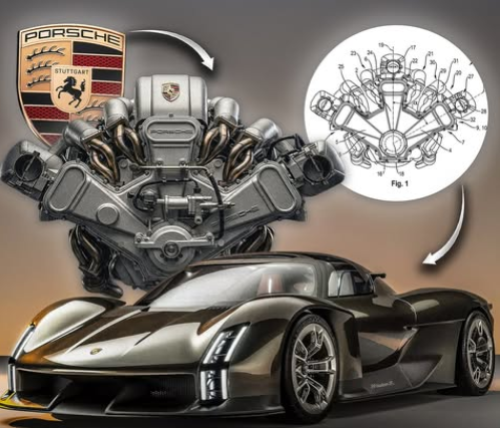
While Porsche is globally celebrated for its iconic flat-six engines, the idea of an 18-cylinder Porsche powerplant has long lived in the realm of motorsport mythology. Enthusiasts often speculate about engineering experiments from the brand’s golden racing era — but the closest Porsche ever came to such an extreme configuration was something even more outrageous.
In the late 1960s, Porsche was determined to conquer the brutal Can-Am championship in North America, a series with minimal restrictions and an appetite for extreme horsepower. This led engineers to develop the now-legendary Porsche 917/30 — a machine so powerful and technically audacious that it has since become one of motorsport’s most feared creations.
Contrary to legend, Porsche never built a single 18-cylinder engine. Instead, for testing and concept evaluation, the company explored pairing multiple engines together. The most dramatic realization of this ambition emerged during experimental development: two 4.5-liter flat-12 engines mounted in parallel, effectively forming a monstrous 12.0-liter, 36-cylinder configuration. Though not used in final competition, this engineering experiment demonstrated Porsche’s pursuit of unmatched output and stability.
By the time the 917/30 reached its definitive Can-Am form, Porsche engineers refined the concept into the famed “Turbo Panzer,” powered by a single 5.4-liter twin-turbo flat-12 that pushed up to 1,580 horsepower in qualifying trim. Its commanding performance made it one of the most dominant race cars ever built, securing both awe and fear among competitors.
The twin-engine prototype, however, remains Porsche’s boldest answer to the hypothetical 18-cylinder dream — a piece of engineering folklore that showcases just how far the automaker was willing to go in pursuit of speed, innovation, and motorsport supremacy.