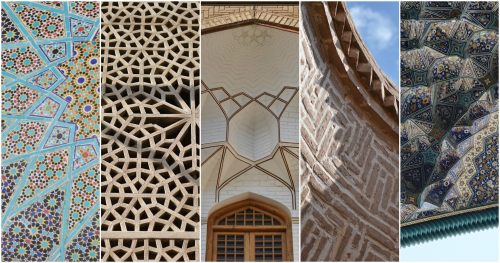
Few architectural elements in the world command attention the way muqarnas does. A signature hallmark of Iranian and broader Islamic architecture, muqarnas presents itself as a breathtaking fusion of structure, mathematics, and spiritual symbolism. With its cascading, honeycomb-like tiers, it transforms ceilings, domes, and entry portals into living sculptures, drawing the viewer into a realm where geometry becomes poetry.
In Iran—home to some of the finest expressions of Islamic art—the use of muqarnas is both ubiquitous and extraordinary. From the interiors of sacred spaces to the monumental gateways of historic complexes, these intricate formations appear to float effortlessly above the viewer, defying the limits of masonry and imagination. Each cell, nook, and prism is crafted with meticulous precision, revealing the depth of expertise passed down through generations of Persian artisans.
Nowhere is this more evident than in Isfahan, considered the architectural heart of Iran. At the Shah Mosque—a masterpiece of 17th-century Safavid design—the muqarnas formations explode with color and complexity. Layered patterns of turquoise, lapis blue, and gold tiles come alive under shifting sunlight, creating a hypnotic dance of shadows that changes from hour to hour. Visitors often pause in silence, mesmerized by the illusion of movement and the sense of infinite depth created by these geometric cascades.
But muqarnas is far more than decoration. Historically, it symbolized a transition—from the earthly world below to the divine space above. Positioned at thresholds, domes, or the entrances of iwans, these formations acted as a bridge between physical and spiritual realms. Their repeating, fractal-like forms represented unity, order, and the vastness of creation, themes central to Persian philosophy and Islamic spirituality.
Today, architects, scholars, and travelers alike continue to marvel at the engineering genius behind muqarnas. Despite its delicate appearance, each layer plays a structural role, distributing weight in ways that allow massive domes and vaults to stand for centuries. Modern computational design has only deepened the appreciation for the mathematical sophistication embedded in this centuries-old art.