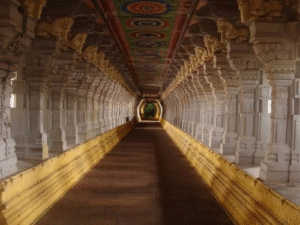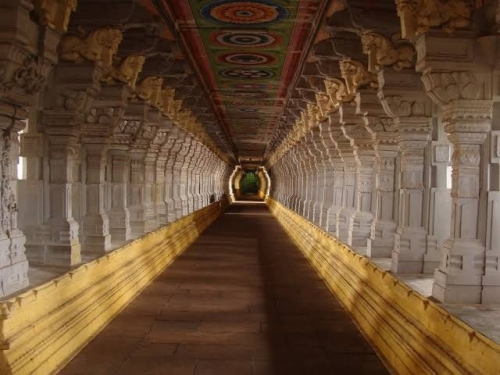
In the sacred town of Rameshwaram, along India’s southern coastline, stands one of the most extraordinary architectural masterpieces ever created — the majestic corridor of the Ramanathaswamy Temple, famed for its astonishing 1212 perfectly aligned pillars. Regarded as one of the world’s longest temple corridors, this engineering marvel continues to captivate historians, architects, devotees, and travelers with its unparalleled precision and grandeur.
The structure, stretching across multiple aisles and flanked by intricately sculpted pillars, demonstrates a level of symmetry and spatial brilliance that modern engineers still marvel at. Each granite pillar is carved to perfection, creating a mesmerizing visual illusion: no matter where you stand, the pillars appear to converge into a single infinite vanishing point, showcasing an advanced mastery of geometry and perspective.
What makes this feat even more astonishing is its timeline. Long before laser measurements, computer modeling, or digital design tools, ancient Indian temple architects achieved an alignment so flawless that it remains unmatched centuries later.
Historical records indicate that the temple’s construction began more than a thousand years ago, with contributions spanning several dynasties. The Pandyas, the Jaffna kings, and later the Sethupathi rulers each played a significant role in expanding its vast corridors, sculpting its pillars, and enriching its design. Some estimates suggest the origins of the earliest shrine date back 1,700+ years, evolving over centuries into the magnificent structure we see today.
Every pillar tells its own story. Carvings of mythological beings, floral motifs, guardians, and intricate patterns reflect the artistic sensibilities of the eras that shaped the temple. The corridor’s sheer scale — stretching nearly 1 kilometer — stands as a testament to the organizational brilliance, craftsmanship, and devotion that defined India’s temple-building heritage.
Today, the Ramanathaswamy Temple isn’t just a place of worship — it is a living museum of ancient Indian engineering. Visitors from across the world walk through its endless aisles in awe, photographing the hypnotic alignment, studying the chiselled granite, and absorbing the spiritual silence that fills the vast stone hallways.