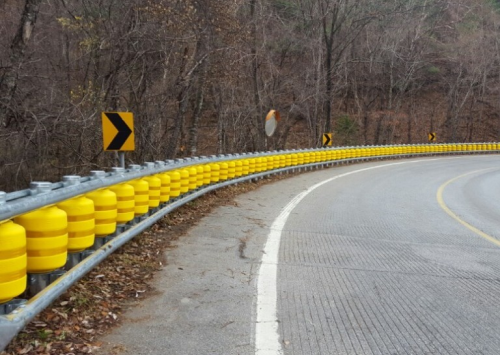
South Korea has emerged as a global leader in road safety innovation with the introduction of its revolutionary rolling barrier system, a design that is transforming how traffic accidents are managed on dangerous roads. Unlike traditional rigid metal guardrails that often worsen the impact of collisions, these barriers use high-elastic polyurethane barrels that rotate when struck, dramatically reducing the force of crashes.
Developed by ETI Co. Ltd, the rolling barrier system works on a simple but powerful principle: converting kinetic energy from a collision into rotational energy. When a vehicle hits the barrier, the barrels spin, absorbing shock and gently redirecting the vehicle back onto the roadway instead of allowing it to overturn, rebound violently, or plunge off cliffs.
The innovation has proven especially effective on sharp curves, steep downhill roads, highway exits, and accident-prone mountain routes. Studies and real-world data show a significant reduction in fatalities, serious injuries, and vehicle damage in areas where the rolling barriers have been installed.
Beyond safety, the system also reduces long-term costs. The durable polyurethane material is weather-resistant, highly visible, and easier to replace than conventional guardrails after accidents. This makes the technology not only life-saving but also economically sustainable for transport authorities.
Originally deployed across South Korea, the rolling barrier concept has now gained international recognition and adoption in several countries around the world. Engineers and urban planners increasingly view it as a model example of how smart design can outperform brute strength in infrastructure safety.