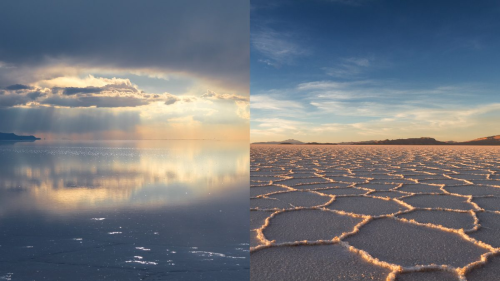
The Salar de Uyuni in Bolivia is celebrated as the largest natural mirror in the world, offering an extraordinary visual spectacle that continues to captivate travelers, photographers, and scientists alike. Formed by the evaporation of prehistoric lakes, this vast salt flat spans over 10,000 square kilometers, creating a reflective surface where the sky and land merge seamlessly into the horizon.
During the rainy season, a thin layer of water transforms the flat into a mirror-like wonder, producing images that seem otherworldly. Visitors describe walking across the Salar as stepping into a boundless sky, where reflections create surreal and unforgettable landscapes. Its ethereal beauty has made the region one of the most photographed natural landmarks on Earth.
Beyond its aesthetic appeal, Salar de Uyuni holds immense geological and economic significance. The area contains one of the world’s largest lithium reserves, a critical component in the production of modern batteries for electronics and electric vehicles. This makes the region not only a natural marvel but also a vital resource in the global push for sustainable energy.
Scientists and researchers study the Salar for insights into climate history, salt flat formation, and lithium extraction methods, while tourism continues to boost the local economy, supporting communities across the region.
Salar de Uyuni remains a unique intersection of natural beauty and scientific value, showcasing the extraordinary wonders of our planet. Whether viewed through the lens of a camera or studied in a laboratory, this immense salt flat continues to inspire awe and admiration, reminding the world of the breathtaking diversity and importance of Earth’s landscapes.