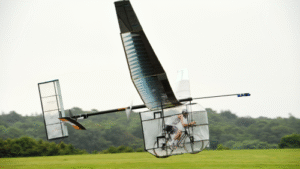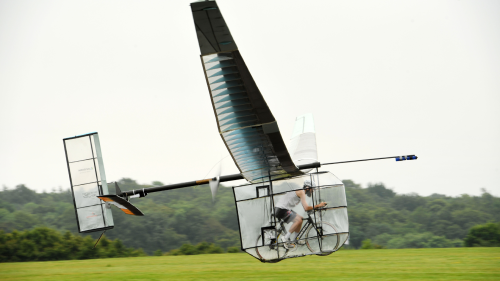
In a remarkable display of innovation and engineering skill, students from Osaka Public University in Japan have successfully built a human-powered aircraft capable of taking off and flying solely through pedaling. The achievement marks an impressive milestone in the world of ultra-light aviation and showcases Japan’s continued leadership in experimental aeronautical technology.
The project was developed by the university’s celebrated Sakai Windmill Association, a research-driven student team renowned for pushing boundaries in low-energy flight. Under the guidance of team leader Fusha Sakai, the group crafted an aircraft built from carbon fiber composites and other ultra-light materials, ensuring maximum strength with minimal weight.
The aircraft features an elongated wingspan engineered to generate substantial lift even at very low speeds. When the pilot begins pedaling, a connected mechanical system powers a large rear propeller, producing enough thrust to lift the aircraft off the runway and sustain controlled flight. The design seamlessly merges the physics of cycling with advanced aerodynamic principles.
The team conducted a series of ground and flight tests outside Osaka, where the aircraft demonstrated stable takeoff, balanced gliding, and responsive steering — all without a single drop of fuel. This project not only highlights the potential of sustainable aviation but also the creativity and passion of young Japanese engineers determined to reimagine transportation.