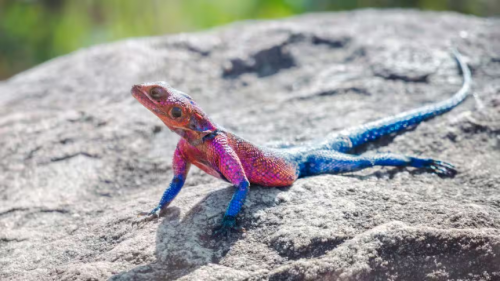
With a fire-red head and a deep blue body, the Mwanza flat-headed rock agama looks like it has stepped straight out of a superhero universe. Its bold coloration and lightning-fast movements have earned it the popular nickname “Spider-Man lizard,” captivating wildlife enthusiasts and social media users around the world.
Native to East Africa, particularly Tanzania and Kenya, this remarkable reptile is best known for the dramatic color display seen in adult males. During mating season, males transform into living bursts of red and blue, using their vibrant appearance to attract females and assert dominance over rivals. The more intense the colors, the stronger the signal of fitness and strength.
In contrast, female Mwanza rock agamas are dressed in muted shades of brown and gray. This natural camouflage allows them to blend seamlessly into rocky landscapes, protecting them from predators while they forage or lay eggs. The striking difference between the sexes makes this species one of the most visually dramatic examples of sexual dimorphism in the reptile world.
These lizards are highly agile and fearless. Often seen basking on sun-warmed rocks, walls, and buildings, they rely on heat to regulate their body temperature. Their powerful limbs and sharp claws allow them to scale vertical surfaces with ease, darting away at incredible speed when threatened—much like their comic-book namesake.
Wildlife experts say the Mwanza flat-headed rock agama plays an important role in its ecosystem, helping control insect populations while serving as prey for birds and larger animals. Despite their bold appearance, they remain masters of survival in harsh, rocky environments.
The growing fascination with the “Spider-Man lizard” highlights how nature often rivals fiction in creativity and design. With no costume and no superpowers beyond evolution itself, this colorful reptile proves that the natural world has been crafting superheroes long before humans imagined them.