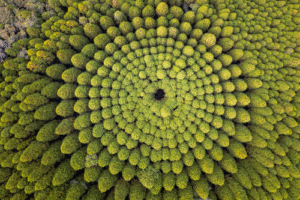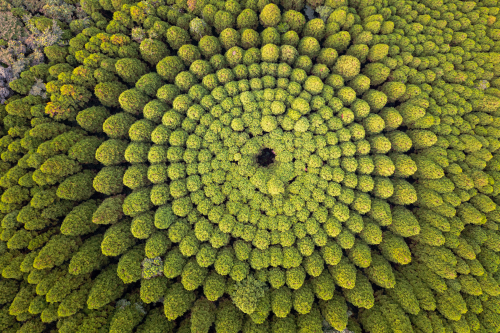
In a breathtaking blend of science, mathematics, and natural beauty, a forest in Miyazaki Prefecture, Japan, has captured global attention for its extraordinary “3D spiral” appearance—a landscape that looks so perfect, many people mistake it for computer graphics. Yet this mesmerizing design is completely real, born from a scientific experiment conducted over 50 years ago.
Back in 1973, researchers in the region set out to determine how spacing affects the growth of cedar trees. To test their hypothesis, they planted the trees in ten concentric circular formations, each ring containing trees placed at different distances from one another. Their expectation was simple: find the optimal spacing for healthy forest growth.
The result, however, turned into a visual masterpiece.
The trees on the outer rings, having more space and access to sunlight, grew taller. Meanwhile, those in the inner circles remained shorter due to tighter spacing. Over the decades, this natural variation in height created a remarkable spiral illusion—a geometric pattern so precise it appears computer-generated from aerial views.
Today, the forest stands as a powerful example of how science and nature can work together to create beauty. On the ground, the forest appears normal. But from above, it transforms into an astonishing artwork—proof that nature can follow rules, patterns, and mathematical discipline when shaped thoughtfully by human hands.