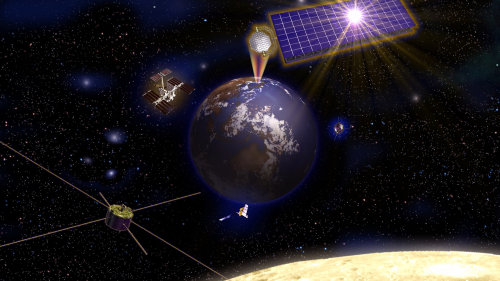
Japan has taken a historic leap in renewable energy by successfully demonstrating the wireless transmission of solar power from space to Earth, achieving a world first with its OHISAMA project in late 2025. The breakthrough proves the concept of space-based solar power (SBSP), offering the potential for continuous, clean energy generation from orbit.
The OHISAMA satellite collects sunlight 24/7 in space, unaffected by night or weather conditions. Using onboard solar panels, the energy is converted into microwaves and beamed down to receiving antennas, known as rectennas, on Earth, where it is reconverted into usable electricity. While the initial demonstration produced a modest 1 kilowatt of power—enough to run a household appliance like a dishwasher—it validates the technology for future large-scale orbital power stations.
The project, named OHISAMA (meaning “sun” in Japanese), reflects Japan’s ambition to harness solar energy directly from space. Researchers envision massive orbital solar arrays capable of generating gigawatts of continuous power, potentially supplying hundreds of thousands of homes and dramatically reducing reliance on fossil fuels.
Experts highlight that space-based solar power could overcome the limitations of traditional Earth-based solar, which is constrained by night and weather conditions, offering a stable, around-the-clock energy source. The technology also holds promise for remote areas, disaster zones, and enhancing global energy independence.
Japan’s OHISAMA project represents a milestone in renewable energy innovation, demonstrating the feasibility of turning orbiting satellites into powerful, clean energy generators. While large-scale deployment is still years away, the successful demonstration establishes Japan as a pioneer in a technology that could transform the future of global energy.