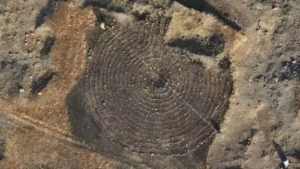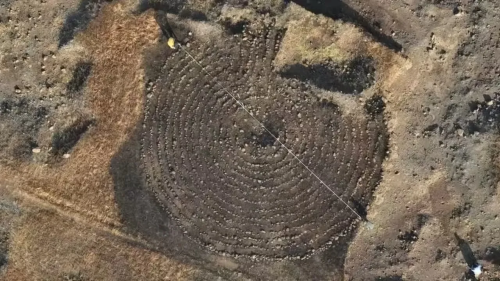
In a remarkable archaeological discovery, what is believed to be India’s largest ancient stone labyrinth has been found in Maharashtra’s Solapur district. The circular labyrinth, located in the Boramani area, features an intricate chakravyuh-like design made entirely of stones, offering new insights into India’s ancient cultural and trade history.
The structure consists of 15 concentric circles arranged in a precise circular pattern and spreads across an area of approximately 50 by 50 feet. Archaeologists describe the layout as highly sophisticated, indicating advanced planning and symbolic significance rather than a simple decorative structure.
The discovery was made by Dr. Sachin Patil, an archaeologist from Deccan College, Pune. Preliminary studies suggest that the labyrinth is more than 2,000 years old, placing it in the early historic period of the Indian subcontinent. Experts believe it may have been used for ritualistic, symbolic, or ceremonial purposes, similar to labyrinths found in other ancient civilizations.
What makes the find particularly significant is its potential connection to ancient global trade networks. Researchers say the design closely resembles labyrinth patterns found in the Mediterranean region, especially those linked to ancient Rome. This has strengthened theories about historical trade relations between the ancient town of Ter in Maharashtra and the Roman world, which were already known through coin finds and artifacts.
Historians note that such labyrinths were often associated with spiritual journeys, meditation practices, or symbolic representations of cosmic order. The Boramani labyrinth’s scale and preservation suggest it held considerable importance in the social or religious life of the people who built it.
The discovery has generated excitement among historians and heritage experts, who believe it could redefine understanding of Maharashtra’s role in ancient international trade and cultural exchange. Further excavation and research are expected to uncover more details about the purpose of the structure and the community that created it.