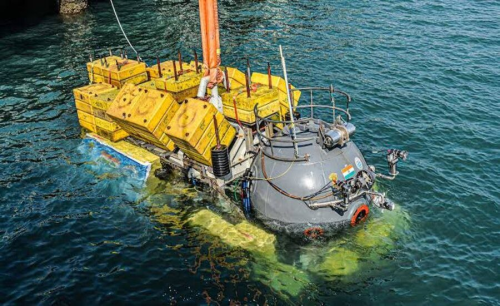
India is on the brink of a groundbreaking milestone as it prepares to send humans deep beneath the ocean’s surface for the first time. The nation’s first indigenous deep-sea submersible, Matsya 6000, developed by the National Institute of Ocean Technology (NIOT) in Chennai, is gearing up for its inaugural test mission off the coast of Tamil Nadu.
Weighing 28 tonnes and engineered with state-of-the-art underwater technology, Matsya 6000 is designed to eventually reach the staggering depth of 6,000 metres—a zone of crushing pressure, darkness, and extreme mystery. As part of its phased testing, the first trial dive early next year will take the submersible to 500 metres, marking a crucial step toward full-scale deep-sea exploration.
Once operational, India will join an elite group of nations—such as the United States, Russia, China, France, and Japan—that possess human-carrying submersibles capable of reaching such extraordinary depths.
Matsya 6000 is a key element of Samudrayaan, India’s first manned deep-ocean mission under the broader Deep Ocean Mission. Its goals are ambitious:
• Unlock the secrets of deep-sea ecosystems
• Observe rarely seen marine species
• Study underwater geophysical processes
• Explore potential mineral and resource deposits on the seabed
At the heart of the submersible lies a pressure-resistant titanium sphere, a compact yet robust capsule that will house three human occupants. This capsule allows scientists and explorers to directly witness life and terrain in the deep ocean—something remote robots and cameras cannot fully replicate.
According to researchers, the human eye’s ability to perceive detail, movement, and subtle ecological behavior makes direct observation invaluable. With scientists physically present at extreme depths, India hopes to make discoveries that could reshape our understanding of marine biology and geology.