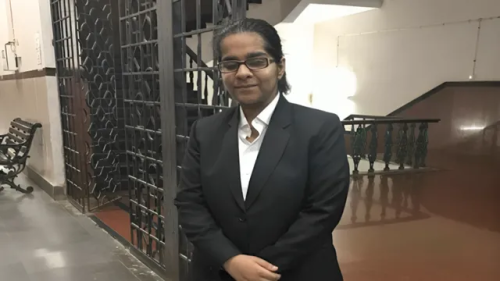
In a landmark moment for India’s legal community, 23-year-old Anchal Bhatheja has rewritten history by becoming the first blind woman lawyer to argue before the Supreme Court of India. Her achievement, recorded on June 6, 2025, has earned admiration nationwide, not just for its symbolic value but for the extraordinary perseverance behind it.
Anchal, who hails from Chandigarh, lost her eyesight completely before she entered Class 10. While many might have seen this as a life-altering setback, Anchal chose to transform it into fuel for her ambition. Refusing to let disability define her capabilities, she went on to top her Class 12 board exams — a feat that caught the attention of educators and disability advocates across the country.
Her academic excellence secured her admission to the National Law School of India University (NLSIU), Bangalore, where she became the institution’s first visually impaired student. Navigating complex legal texts, research work, and competitive academic sessions, Anchal excelled once again, graduating with honors. Professors recall her as a student of rare brilliance, unmatched diligence, and unwavering focus.
On the historic day of her Supreme Court debut, Anchal stood confidently before the bench, assisted by adaptive technology and months of rigorous preparation. Her arguments were sharp, well-researched, and delivered with extraordinary clarity — prompting appreciation from legal experts and inspiring countless individuals with disabilities across India.
Her journey is now being hailed as a powerful testament to resilience and equality. “Disability is not inability,” she told reporters after the hearing. “Barriers exist only until we decide to break them.”
As the world observes the International Day of Persons with Disabilities, Anchal’s story stands as a beacon of hope, highlighting the profound impact of accessible education, inclusive policy, and personal courage. Her achievement has sparked renewed conversations about equal opportunities in India’s legal ecosystem, from courtroom accessibility to technologically assisted learning.