On the shores of Babolsar in northern Iran, the proposed Houpé Tower has emerged as one of the most imaginative architectural concepts of the decade — a vertical coastal neighborhood that blends cultural heritage with contemporary design. Although still unbuilt, the project has already earned international recognition, securing the 2024 World Architecture Festival Award in the mixed-use category for its bold reinterpretation of community living.
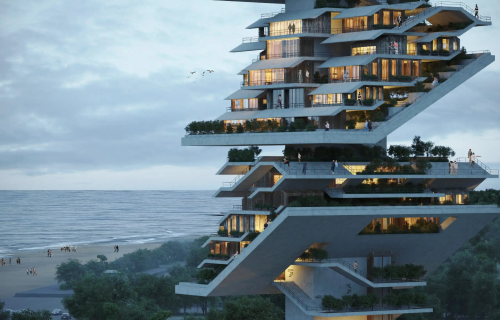
Inspired by the historic “Shoupé” night guards who once protected rice fields across Mazandaran, the tower pays tribute to a traditional symbol of vigilance and harmony with the land. Rising 18 stories and spanning 22,000 square meters, Houpé Tower is envisioned not merely as a high-rise, but as a thriving micro-city structured around shared life, public engagement, and natural views.
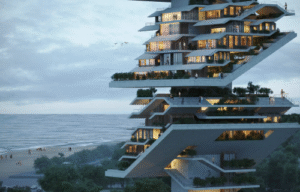
Borrowing spatial concepts from Iran’s mountain villages, the design breaks the tower into three stacked neighborhoods, each rotated to offer shifting vistas of the Caspian Sea, the cityscape, and the surrounding farmlands. This rotation forms varied terraces and voids, ensuring that sunlight, airflow, and visual openness become integral parts of the living experience.
Within the tower, an intricate network of alleys, pathways, platforms, and plazas connects residents through semi-public and social spaces. These features — reminiscent of village footpaths — foster interaction and create a continuous sense of community in a vertical environment. Small markets, lounges, green courtyards, and shared amenities are woven throughout, echoing the spirit of communal life found in traditional Iranian settlements.
At the ground level, a two-story podium serves as the project’s urban anchor, creating a lively interface between city and coast. Designed as a fluid passage, it allows pedestrians to move seamlessly from Babolsar’s streets to the beach, establishing the tower not as a barrier but as a connective cultural bridge.
Architectural critics have praised the project for its blend of cultural memory, environmental sensitivity, and urban innovation. The use of village-inspired geometry in a high-rise setting, along with its human-centered spatial planning, positions Houpé Tower as a pioneering model for the future of coastal development in Iran and beyond.
While the tower remains unbuilt, its global recognition marks a significant milestone for contemporary Iranian architecture — proving that visionary, community-focused design can transcend physical construction to inspire the world.