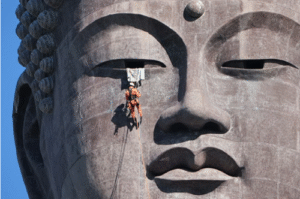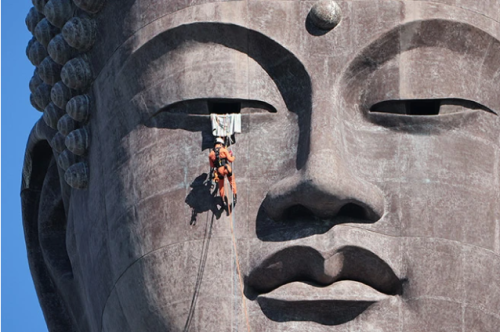
The iconic Ibaraki Buddha, a Guinness World Record holder and one of Japan’s most striking landmarks, has become the centre of an important disaster preparedness and rescue training exercise in Ibaraki Prefecture, Japan. Known globally for its immense size and cultural significance, the towering statue was transformed into a practical training site aimed at strengthening emergency response capabilities.
Standing over 120 metres tall, the Ibaraki Buddha is officially recognised by Guinness World Records as one of the tallest bronze statues in the world. During the recent exercise, rescue teams, firefighters, and emergency responders used the structure to simulate real-life disaster scenarios, including high-altitude rescues, evacuations, and coordination drills.
The training focused on preparing teams for earthquakes, fires, and other large-scale emergencies that could affect tall structures and crowded public spaces. Using the Buddha’s internal stairways, observation decks, and surrounding grounds, responders practiced rapid response techniques, victim evacuation methods, and communication under pressure.
Officials said the choice of location was symbolic as well as practical. The Buddha is not only a place of spiritual reflection and tourism, but also a massive structure that presents unique rescue challenges. Conducting drills at such a site allows teams to test their skills in realistic conditions while ensuring the safety of visitors in the future.
Local authorities highlighted that combining cultural landmarks with safety training sends a strong message about preparedness and community resilience. The event also attracted public attention, helping raise awareness about the importance of disaster readiness in a country frequently affected by natural calamities.