In April 2025, ASML CEO Christophe Fouquet reassured investors that China was still “many, many years” away from developing extreme ultraviolet (EUV) lithography technology. His predecessor had gone even further, declaring China was “light-years behind”, while Western analysts largely agreed that EUV capability in China was at least 10 to 15 years away.
Those estimates have now been dramatically upended. According to multiple industry sources, a secret laboratory in Shenzhen quietly completed a working EUV lithography prototype in early 2025, years ahead of Western expectations. The massive system—so large it occupies an entire factory floor—has successfully generated extreme ultraviolet light, the core technological hurdle of advanced chip manufacturing.
China’s internal roadmap reportedly targets working EUV-produced chips by 2028, with more conservative projections pointing to 2030. Even the slowest estimate places China 15 to 25 years ahead of the timelines publicly stated by ASML leadership and Western semiconductor analysts.
At the heart of the breakthrough lies an aggressive talent acquisition strategy. Former ASML engineers, including Lin Nan, the company’s former head of light source technology, were recruited with signing bonuses reportedly reaching $700,000, along with housing subsidies and state-backed protections. Sources say engineers worked under false identities, with their roles classified as national security projects.
Lin Nan’s team alone filed eight EUV-related patents in just 18 months, a pace that stunned semiconductor observers familiar with the complexity of EUV systems. These patents reportedly cover light source stability, plasma generation, and optical control—areas long considered near-impossible to replicate without decades of iterative experience.
China also pursued a parallel strategy of hardware reverse engineering. Older lithography equipment from ASML, Nikon, and Canon was acquired via secondary markets, including Alibaba Auction, with listings appearing as recently as October 2025. Once acquired, more than 100 graduate engineers reportedly dismantled the machines component by component.
Each engineer worked under constant camera surveillance, receiving cash bonuses for successfully reassembling individual subsystems. The process allowed China to reconstruct knowledge across optics, vacuum systems, precision mechanics, and control software—effectively rebuilding lithography expertise from the ground up.
ASML’s long-standing legal concerns now appear vindicated but unresolved. In 2019, ASML won an $845 million judgment against a former Chinese engineer for trade secret theft. The individual declared bankruptcy, relocated to Beijing, and continued working in the semiconductor sector with state backing. The judgment was never enforced.
Warnings had been issued before. In 2023, then-ASML CEO Peter Wennink cautioned Western policymakers: “You’re forcing them to become very innovative. They’re coming up with solutions we haven’t thought of.” At the time, the comment was widely dismissed as rhetorical. Two years later, it reads as prescient.
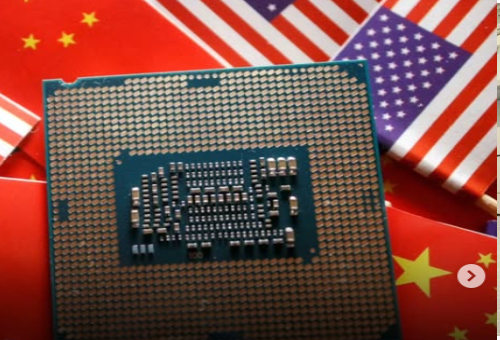
China’s EUV progress underscores a growing reality in global technology competition: export controls may slow access, but they can accelerate reinvention. What was once considered an insurmountable monopoly is now facing a parallel ecosystem built through talent migration, reverse engineering, and state-level coordination.