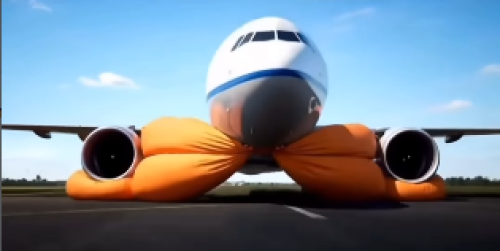
In a dramatic leap forward for global aviation safety, China has successfully tested a revolutionary airbag-based emergency landing system designed to cushion aircraft during critical in-flight failures. The breakthrough technology, which deploys massive, high-pressure airbags beneath an aircraft in the final seconds before impact, could fundamentally reshape how emergency landings are handled in both civilian and military aviation.
The system works through an intelligent chain of real-time detection. When onboard AI sensors identify an event such as engine failure, hydraulic loss, or landing-gear malfunction, the aircraft initiates an automated protective sequence. Just moments before touchdown, large airbags inflate from compartments in the undercarriage, creating a soft, shock-absorbing barrier between the aircraft and the ground.
During China’s latest test, engineers simulated an engine-out scenario mid-flight. As the aircraft descended, the system deployed precisely on cue, expanding in a fraction of a second. Ground observers reported that the resulting landing was remarkably smooth, with the airbag cushions distributing impact forces evenly across the fuselage—an outcome previously considered nearly impossible in an off-runway emergency.
Experts say the technology addresses one of aviation’s most challenging problems: crash landings on rough, uneven, or improvised terrains, where traditional landing gear provides limited protection. By absorbing and reducing the high-energy forces of impact, these inflatable systems could significantly lower the risk of catastrophic damage and severe injuries.
Aviation engineers also highlight the system’s versatility. With further refinement, the airbag mechanism could be adapted for regional aircraft, military transports, unmanned drones, and next-generation air taxis—vehicles expected to operate in varied environments where controlled emergency landings may be crucial.
Beyond the technical achievement, the development marks a major conceptual shift: redefining safety not only as the prevention of accidents but also the mitigation of impact when emergencies occur. The integration of AI-driven detection and rapid-response engineering demonstrates how future aircraft may autonomously protect themselves and their passengers.
As global regulators and aerospace manufacturers monitor China’s progress, the successful test underscores a future where emergency landings become far less deadly. If the technology achieves widespread adoption, airbags may one day be as essential to aircraft as they are to automobiles—ushering in a new, safer chapter in aviation history.