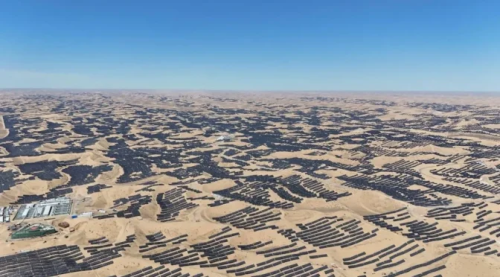
China has taken a groundbreaking leap in renewable energy by installing 40,000 acres of solar panels across deserts, coastal regions, and mountain terrains—without using even an inch of agricultural land. The project, hailed as one of the most efficient and eco-conscious solar expansions in the world, demonstrates how renewable infrastructure can grow without compromising food security.
Chinese environmental agencies revealed that the mega solar installations—spread across the Gobi Desert, offshore floating platforms, and high-altitude plateaus—are designed to maximize solar output while preserving fertile soil for farming. The combination of desert solar farms, floating photovoltaic systems, and mountain-mounted arrays showcases China’s strategic approach to balancing energy growth with land conservation.
The initiative is expected to generate several gigawatts of clean energy, significantly contributing to China’s goal of achieving carbon neutrality by 2060.
However, the development has reignited debate in India, where critics claim that some large-scale solar projects are being built on fertile agricultural land. Activists and local farmers in states like Rajasthan and Gujarat allege that companies—including major players like Adani Green Energy—have labeled productive farmlands as “barren” to acquire them for solar parks.
Environmental experts argue that India, like China, has abundant non-farming spaces such as deserts, dry plateaus, and saline wastelands that could host solar installations without impacting crop production.
“Renewable energy is essential, but so is food security. India must prioritize unused or non-arable land for such projects,” said a senior environmental analyst from New Delhi.
The comparison between China’s land-conscious renewable strategy and India’s ongoing disputes has sparked a nationwide discussion on sustainable development. Policy makers are now facing increasing pressure to revise land-use guidelines and ensure that green energy growth does not come at the cost of agricultural livelihoods.
As nations progress toward clean-energy futures, the contrasting approaches of China and India highlight the crucial balance between expanding renewable power and protecting essential farmland.