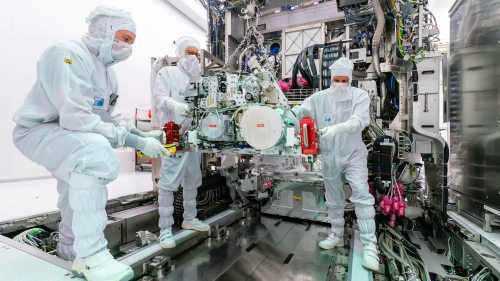
China’s semiconductor industry has reportedly reached a historic milestone with the development of its first domestic extreme ultraviolet (EUV) lithography prototype, a technology critical for producing the world’s most advanced microchips. Until now, EUV lithography has been the exclusive domain of Dutch firm ASML, and China’s access has been heavily restricted by US export controls.
According to reports, Chinese firms, including Semiconductor Manufacturing International Corporation (SMIC), have worked to replicate EUV systems, studying older ASML components and investing significant resources into research and development. Reuters indicates that China has successfully built a functional prototype, surpassing many experts’ expectations about the timeline for achieving this advanced technology.
EUV machines operate by firing powerful lasers at tiny droplets of molten tin to produce ultraviolet light, which is then used to etch circuits onto silicon wafers with nanometer precision. ASML spent over €6 billion and 17 years perfecting the technology. While China is not yet producing chips using EUV lithography, the country aims to make the technology operational by 2030.
This milestone comes amid intensifying global competition in the semiconductor sector, driven by the AI boom. In China, companies like Huawei are expanding chip manufacturing alongside SMIC, while the US continues to heavily invest in domestic chip production under the CHIPS and Science Act. Analysts view China’s EUV development as a significant step toward reducing dependence on foreign technology and strengthening national capabilities in advanced chip fabrication.
The breakthrough underscores the growing strategic importance of semiconductors in global technology, national security, and AI development, signaling that the international chip race is entering a new, high-stakes phase.