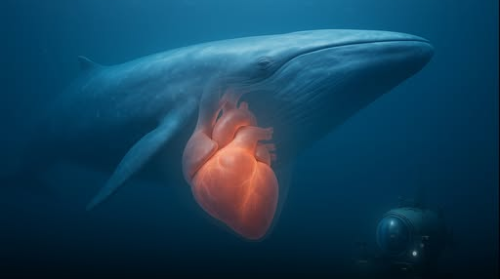
Marine biologists studying one of Earth’s most extraordinary creatures have documented a remarkable anatomical wonder—the blue whale’s heart, the largest ever measured in any animal. Weighing up to 200 kilograms, roughly the size of a small motorcycle, this massive heart powers a body longer than a commercial passenger jet.
The measurements were recorded by research teams from Canadian and American institutions during rare deep-sea necropsies. These opportunities allow scientists to study blue whale physiology up close, something nearly impossible while the animals are alive due to their immense size and deep-ocean lifestyle.
Researchers say the blue whale heart is a marvel of extreme biological engineering. It pumps hundreds of liters of blood with each beat, circulating life through a body that can stretch over 30 meters. Studying such colossal cardiovascular systems helps scientists understand biological scaling, survival mechanisms, and the upper limits of animal anatomy.
The findings also allow researchers to compare human cardiovascular physiology with that of the planet’s largest animal—revealing how different species adapt structurally and functionally to their size.
This rare discovery continues to fascinate marine biologists and deepen our understanding of life in Earth’s oceans, reminding us how little we truly know about the giants beneath the waves.